Compare
11 best places to find a cofounder, and where cofounders actually meet
Most cofounders meet through people they already know. Here is every kind of place to look, what it costs to start, and how much of the work is left to you.
On this page
Where do cofounders actually meet?
Most lists of places to find a cofounder start with websites. The survey data starts somewhere else. In a Censuswide survey of 500 people for Starling Bank, published in April 2026, 60% said they met their cofounder by chance (startups.co.uk). These are the routes they named:
| Where they met | Share of respondents |
|---|---|
| Through friends and family | 34% |
| At a former workplace | 26% |
| At school or university | 25% |
| Through a professional association or community event | 17% |
| At a coworking space | 16% |
| At a dedicated networking event | 15% |
Some people named more than one route, so the figures add up to more than 100%. The survey has no figure for meeting online. Stripe offers a clue: 24% of Stripe Atlas startups with more than one founder have founders in different countries, and about half of the teams Stripe surveyed had met entirely online, usually through professional projects (Stripe).
In the top three routes, you see someone's work for months first. Every other place has to make up for that missing history, so that's what we compare. We build Foundinity, so it comes first.
The options at a glance
| Place | Cost to start | How you meet people | What's left to you |
|---|---|---|---|
 Foundinity | Free; Plus $5 a week or $15 a month | Ranked by compatibility on multiple dimensions around who you are and how you work | Like the people you want to meet, then book the intro call in the app |
| Former colleagues | Free | People who have already seen your work | Finding someone ready to start something |
| Friends and family | Free | Introductions from people who know you | Saying exactly who you need, judging fit |
| University and alumni networks | Varies by university | Classmates, alumni groups, entrepreneurship centres | Finding who's serious, following up |
| Founder events and meetups | Free or a ticket price | Conversations at an event | Working out who's serious, going back |
| Startup Weekend and hackathons | Set by each event | Building something as a team | Getting there, following up afterwards |
| Coworking spaces | A day pass or membership | Working near the same people for months | Turning familiar faces into a conversation |
| Online founder communities | Free | Forum posts, groups, open source projects | Writing the post, searching, reaching out |
| Entrepreneur First, Antler | Selective; full-time | Cohorts where teams form | Getting in, leaving your job |
| YC's cofounder matching | Free | Browse approved profiles; 20 invites a week | Sorting profiles, judging fit, following up |
| CoFoundersLab | Limited free tier; Premium $29 a month after a 30-day trial | Search a directory | Checking who's real, judging fit, cancelling in time |
Foundinity: built to show fit before you meet
Foundinity is a cofounder matching platform. You state what you need in a cofounder, and answer an assessment about how you work: commitment, working style, ambition, personality, goals, values, alongside your skills and interests. A multi-trait algorithm built on established psychological compatibility models ranks the people you see, so you start with compatible people instead of hundreds of random profiles.
That fills the gap the survey points to. With a former colleague, you know what happens when a deadline slips. With someone new, the compatibility breakdown on every match shows where you align and where you differ. When you both like each other, it's a match: a 10-day clock starts, and you book the intro call in the app.
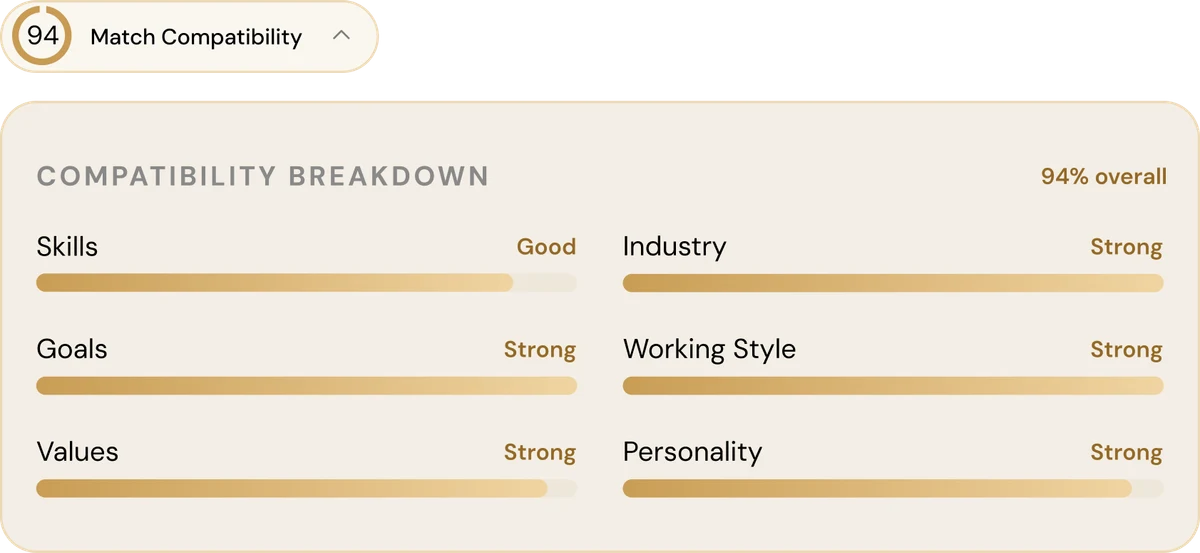
Only compatible members can see your profile, so you can look while employed, and an exploring status lets you meet people before you're ready to commit.
What it costs. Free to get started: 5 likes a week, up to 3 active matches and up to 3 profile saves. Plus costs $5 a week or $15 a month (₹300 or ₹1,000 in India) and adds 15 likes a week, unlimited active matches, everyone who liked you, and up to 5 profile saves.
Who it's for. Anyone whose own circle hasn't turned up a cofounder yet. More on how it works and pricing.
Your own network
The survey ranks these routes highest, and each works well alongside a platform.
1. Former colleagues
What it is. Old teammates, clients, suppliers, people from a previous startup. A former workplace was where 26% of respondents met their cofounder.
What to know. You already know how they work, the hardest thing to learn about anyone new. The limit is timing: good people are often settled in jobs they like. A no can still come with a name, so ask who the strongest person they've worked with is.
With Foundinity. Go through your old teams first. If nobody is free, Foundinity shows how someone works before the first call, which is part of what a shared job gives you.
2. Friends and family
What it is. Introductions through people who know you, the most common route in the survey at 34%.
What to know. A friend can vouch for a person, but they can't know how the two of you would work together. Say exactly who you need: "someone who has sold software to hospitals" brings a name to mind, "a cofounder" doesn't. Pillar VC advises caution about starting a company with family.
With Foundinity. Use both. The compatibility breakdown adds what an introduction can't, such as where your goals or working styles differ.
3. School, university and alumni networks
What it is. Classmates, alumni groups, entrepreneurship centres and student societies. A quarter of respondents (25%) met their cofounder at school or university.
What to know. Strongest while you're studying or soon after, when people have time. Later, alumni events are the way back in. Pillar VC also suggests university job boards and club leaders, beyond the top-ranked schools.
With Foundinity. If your classmates have scattered into jobs, Foundinity shows you who is looking now, ranked by compatibility.
Events and shared spaces
4. Founder events and meetups
What it is. Founder meetups, industry association events and conferences, plus online events such as Founder Institute's virtual cofounder networking sessions, open to anyone. Professional associations and community events accounted for 17% in the survey, networking events 15%.
What to know. Founder Institute says it doesn't guarantee you'll find a cofounder. An hour of talk shows who is interesting; reliability takes longer to see, so go back and meet people more than once.
With Foundinity. Go to events and match on Foundinity in between. Whoever looks promising gets the same trial project.
5. Startup Weekend and hackathons
What it is. Techstars Startup Weekend is a three-day event, billed as 54 hours, where people pitch ideas, form teams and build something. Hackathons work the same way. Devpost lists online hackathons next to in-person ones, and many of the online ones run for several weeks.
What to know. A weekend shows how someone works under pressure. It says less about how they'll hold up over months.
With Foundinity. A hackathon makes a ready-made trial. Match on Foundinity, enter one together and see how you split the work.
6. Coworking spaces
What it is. Shared offices where you work near the same people for months. 16% of respondents met their cofounder in one.
What to know. It's slow, and it works for the same reason a former workplace does: you see people work before you talk business. Many people around you may have no plans to start anything.
With Foundinity. Matched with someone in your city? A week side by side in a coworking space makes a good part of a trial.
Online communities
7. Founder forums, industry groups and open source
What it is. Forums such as Indie Hackers and Reddit's founder subreddits, industry Slack and Discord groups, and open source projects. OneUp's founders, one in the US and one in India, met through a partner-up post on Indie Hackers and ran the company remotely for five and a half years before meeting in person.
What to know. Nothing here is built for a cofounder search, and nobody checks who is posting. Indie Hackers retired its "Looking to Partner Up" group in 2026, so requests are ordinary posts. The upside: you can read months of someone's posts, or their code, before you get in touch.
Where Foundinity differs. On a forum you write the post and wait. On Foundinity everyone is there to meet a cofounder, and the people you see are already ranked by compatibility.
Full-time programmes
8. Entrepreneur First and Antler
What they are. Programmes that take individuals, usually without a cofounder or an idea, and help them form teams. Antler's UK residency runs for up to eight weeks in London, in person. Entrepreneur First expects participants full-time in one of its hub cities.
What to know. Both are selective: Antler says it backs fewer than 1% of applicants. Both mean leaving your job, and you team up within your cohort.
Where Foundinity differs. You don't have to quit anything or wait for a cohort. Set your status to exploring and meet people while you're still employed.
Cofounder platforms
9. YC's cofounder matching
What it is. Y Combinator's free directory of founder profiles, run through Startup School. Once your profile is approved, you browse other approved profiles and send invites.
What to know. Approval can take up to a week, according to Startup School's FAQ, and invites are capped at 20 a week. Members can be removed for going unresponsive after a match. In-person meetups are only in San Francisco and New York. More in YC cofounder matching alternatives.
Where Foundinity differs. Foundinity ranks people by compatibility, shows where you align and differ on every match, and puts a 10-day clock on each one.
10. CoFoundersLab
What it is. A directory of founder profiles that you search and message yourself. Premium costs $29 a month after a 30-day free trial; the free tier is labelled "Limited".
What to know. On Trustpilot it scores 1.3 from 107 reviews, 94% of them one star, with complaints about spam, fake profiles, deleting accounts and cancelling. Its terms say the trial turns into automatic payments unless you cancel before the renewal date. More in CoFoundersLab alternatives.
Where Foundinity differs. Foundinity is free to get started, Plus can be paid by the week, and the people you see are ranked by compatibility instead of left for you to search.
Which should you use?
Start with people who already know your work: former colleagues, classmates and friends who can introduce you. Run Foundinity alongside, so that if your circle comes up empty you're already talking to compatible people. Add one in-person format, such as a founder event or a hackathon. Choose a full-time programme only if you're ready to leave your job now.
FAQ
Where is the best place to find a cofounder?
Most cofounders meet through people they already know: friends and family, a former workplace, or school or university. If they don't turn up anyone, try a place built for meeting new people, such as Foundinity, and test whoever you meet with a short project.
Where can I find a cofounder online?
On matching platforms such as Foundinity, in founder forums and industry groups, through open source projects, at online hackathons and at virtual events. Our guide on how to find a remote cofounder covers testing someone at a distance.
Where can I find a technical cofounder?
Where engineers spend time: former engineering colleagues, hackathons, open source projects and developer communities. See how to find a technical cofounder.
Are cofounder matching platforms worth it?
They make meeting people quick, which moves the work to testing them. The Whalesync founders met on YC's platform in 2021 and ran a six-week trial before starting the company.
Sources
- Starling Bank and Censuswide survey of 500 respondents, reported by startups.co.uk, 29 April 2026, checked 6 November 2026.
- Stripe, "Stripe Atlas startups in 2025: Year in review", 18 December 2025.
- Pillar VC, "How To Find a Co-Founder or Early Startup Team Member", checked 6 November 2026.
- Indie Hackers, post by Davis Baer (1 February 2024) and closed group page; Devpost listings; both checked 6 November 2026.
- Techstars Startup Weekend (techstars.com/communities/startup-weekend), Founder Institute (fi.co/find-a-cofounder), Antler UK (antler.co/uk), Entrepreneur First (joinef.com/faqs), checked 6 November 2026.
- Startup School FAQ (startupschool.org/faq), Y Combinator (ycombinator.com/cofounder-matching), CoFoundersLab (cofounderslab.com/premium, /terms) and Trustpilot, checked 6 November 2026.
- Whalesync, cofounder matching playbook, 8 May 2023.