Compare
CoFoundersLab alternatives: where else to find a cofounder
CoFoundersLab's reviews are mostly one star, and Premium costs $29 a month after the trial. Here's what to use instead.
On this page
Why people leave CoFoundersLab
The reviews point to the experience. On Trustpilot, CoFoundersLab has a TrustScore of 1.3 from 107 reviews, and 94% of them are one star (checked 6 November 2026). The same complaints come up again and again: marketing emails people can't unsubscribe from, fake profiles, slow pages and notifications that don't arrive, accounts that are hard to delete, and support that doesn't reply.
Then there's the billing. Premium is $29 a month, and the 30-day free trial turns into paid billing on its own. CoFoundersLab's terms say that after the trial "you consent to automatic payments", that it may keep billing a card even after the card has expired, and that you need to cancel before the renewal date to avoid charges.
And the checking is left to you. The terms say CoFoundersLab doesn't "warrant the accuracy, completeness, or usefulness" of information on the site, and they don't describe any checks on members.
The options at a glance
| Option | Cost to start | How you find people | What's left to you |
|---|---|---|---|
 Foundinity | Free; Plus $5 a week or $15 a month | Ranked by compatibility on multiple dimensions around who you are and how you work | Like the people you want to meet, then book the intro call in the app |
| YC's cofounder matching | Free | Browse approved profiles; up to 20 invites a week | Sorting profiles, judging fit, following up |
| Founder Institute events | No fee listed | Online networking events | Working out who's serious, following up |
| Startup Weekend and hackathons | Set by each event | Form a team over a weekend | Getting there, following up afterwards |
| Indie Hackers | Free | Forum posts | Writing the post, searching, reaching out |
| Free; InMail needs Premium | Search people's work history | Finding who's open to it, getting introductions | |
| Entrepreneur First, Antler | Selective; full-time | Cohorts where teams form | Getting in, leaving your job |
Foundinity: matched on how you work
Foundinity is a cofounder matching platform. You state what you need in a cofounder, and answer an assessment about how you work: commitment, working style, ambition, personality, goals, values, alongside your skills and interests. A multi-trait algorithm built on established psychological compatibility models ranks the people you see, so you're looking at compatible people instead of scrolling through hundreds of random profiles.
Every match shows a compatibility breakdown: where you align and where you differ, so you know what to talk about on the first call. When you and someone else both like each other, it's a match, and a 10-day clock starts so the conversation doesn't sit unanswered. You book the intro call inside the app. Your profile isn't public; only members who are compatible with you can see it. If you aren't ready to commit yet, set your status to exploring and meet people at your own pace.
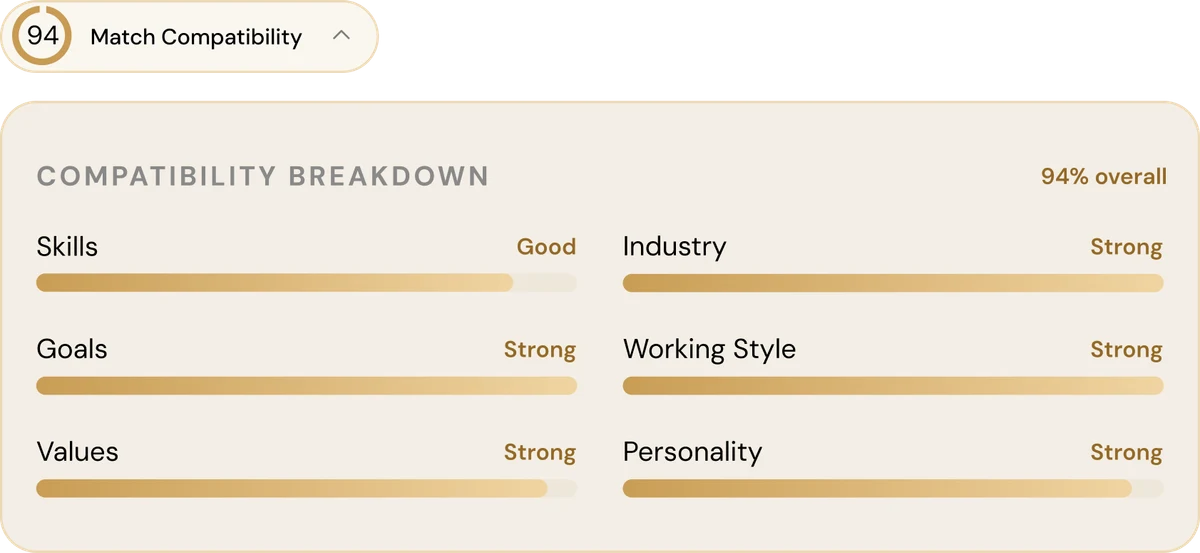
What it costs. Free to get started: 5 likes a week, up to 3 active matches and 3 profile saves. Plus costs $5 a week or $15 a month (₹300 or ₹1,000 in India) and adds 15 likes a week, unlimited active matches and a list of everyone who liked you.
Who it's for. Anyone who knows the skills they need and wants to find out early whether someone will work the way they do. More on how it works and pricing.
Other options
1. YC's cofounder matching
What it is. A free directory of founder profiles run by Y Combinator. You fill in a profile, wait for approval, then browse other approved profiles and invite the people you want to talk to. When someone accepts, you set up a call.
What to know. Approval can take up to a week, according to Startup School's FAQ, and invites are capped at 20 a week. Sorting through profiles and judging fit is up to you.
Where Foundinity differs. Foundinity asks how you work, ranks people by compatibility, and shows where the two of you align and differ before the first call. Every match gets a 10-day clock.
2. Founder Institute's online cofounder events
What it is. Virtual networking events for people looking for a cofounder, open to anyone.
What to know. Founder Institute states that it doesn't guarantee you'll find a cofounder. The events are for meeting people; any follow-up is up to you.
Where Foundinity differs. An hour of networking tells you little about how someone works. On Foundinity, the compatibility breakdown shows that before you spend time on a call.
3. Startup Weekend and hackathons
What it is. Techstars Startup Weekend is a 54-hour event where people pitch ideas, form teams and build something by Sunday. Hackathons work the same way, with more code.
What to know. Events are local and dates vary. A weekend shows how someone works at speed; it tells you less about how they'll hold up over months.
With Foundinity. A weekend makes a good trial once you've found someone. Match on Foundinity, then take on a hackathon together and see how it goes.
4. Indie Hackers
What it is. A free forum where founders post about what they're building.
What to know. There's nothing set up for a cofounder search. Its "Looking to Partner Up" group closed in 2026, so requests are now ordinary posts that you write and search for yourself.
Where Foundinity differs. On a forum you write the post and wait. On Foundinity, the people you see are already ranked by compatibility on multiple dimensions around who you are and how you work.
5. LinkedIn
What it is. A place to look up someone's work history and ask a mutual contact for an introduction.
What to know. Most people on LinkedIn aren't looking for a cofounder, and messaging people outside your network takes InMail. LinkedIn's Premium Career plan includes 5 InMail credits a month.
Where Foundinity differs. Everyone on Foundinity is there for a cofounder, now or later, and your profile isn't public, so you can look while you're still employed.
6. Entrepreneur First and Antler
What they are. Full-time programmes that take individuals and help them form teams. Antler's UK residency runs for up to eight weeks, in person.
What to know. Both are selective; Antler says it backs under 1% of applicants. Both expect you full-time, which usually means leaving your job first.
Where Foundinity differs. You don't have to quit anything to start. Set your status to exploring and meet people at your own pace.
Which should you use?
If you want to know how someone works before you spend weeks on calls, start with Foundinity. Add one in-person format, like a Startup Weekend or a local founder event, so you also meet people face to face; it's a good setting for a trial with someone you matched with. If you're ready to leave your job now, a full-time programme is the other route.
FAQ
Is CoFoundersLab free?
It has a free tier. Premium costs $29 a month after a 30-day free trial, and the trial turns into paid billing unless you cancel before the renewal date.
Is CoFoundersLab legit?
It's a real platform, but its reviews are poor: 1.3 on Trustpilot from 107 reviews, with complaints about spam, fake profiles and cancelling. Its terms don't promise that member information is accurate, and they don't describe any checks on members. If you use it, verify people yourself: look them up elsewhere, get on a call early and do a short trial project before you commit your time.
What's the best free alternative to CoFoundersLab?
Foundinity is free to get started, with 5 likes a week, up to 3 active matches and a compatibility breakdown on every match. Events and forums cost nothing too, but there you do the searching yourself.
How do I avoid fake profiles on cofounder sites?
Look the person up outside the platform, get on a video call early, ask what they've built and check it, and do a small trial project before you commit. Be wary of anyone who asks you for money.
Sources
- Trustpilot, CoFoundersLab reviews, checked 6 November 2026.
- CoFoundersLab pricing page and terms (cofounderslab.com/premium, cofounderslab.com/terms), checked 6 November 2026.
- Startup School FAQ (startupschool.org/faq) and Y Combinator cofounder matching page (ycombinator.com/cofounder-matching), checked 6 November 2026.
- Founder Institute (fi.co/find-a-cofounder), checked 6 November 2026.
- Techstars Startup Weekend (techstars.com/communities/startup-weekend), checked 22 October 2026.
- Indie Hackers "Looking to Partner Up" group page (closed), checked 8 October 2026.
- LinkedIn Help, InMail credits on Premium (linkedin.com/help/linkedin/answer/a541643), checked 22 October 2026.
- Antler UK (antler.co/uk), checked 22 October 2026.