Blog
Tinder for cofounders? Why swiping is the wrong way to choose the person you'll build a company with
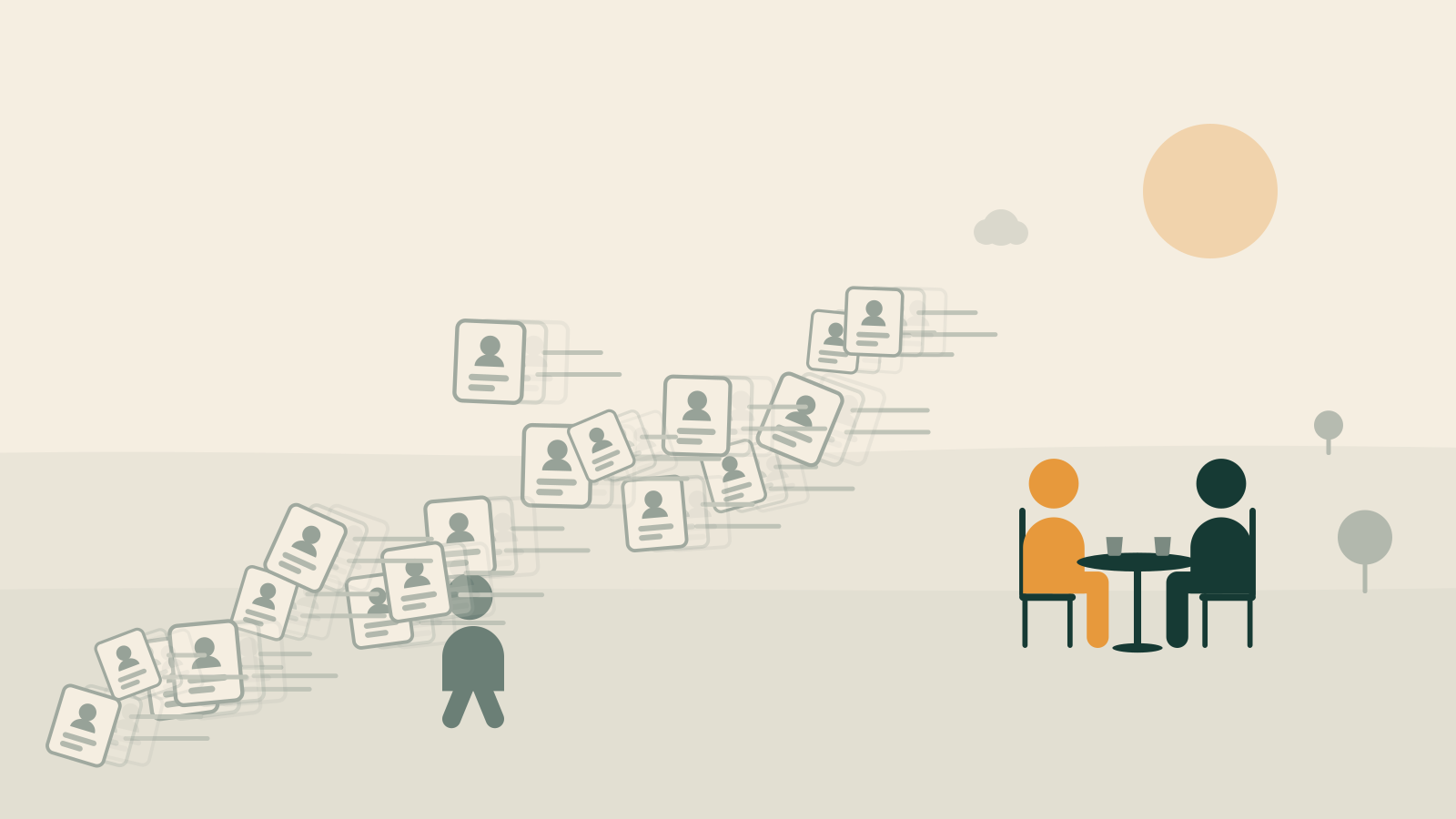
Swiping feels productive. You rack up matches, every one feels like progress, and none of it tells you whether you could build a company with that person for years.
On this page
- Why the idea is so appealing
- What swiping is built for
- More matches doesn't mean a better cofounder
- The dopamine problem
- Choosing a cofounder is closer to choosing a partner
- What a profile can't tell you
- The other dating-app model: built to get you off the app
- What we built instead
- How to use any matching app without the swipe habit
- So, is there a Tinder for cofounders?
- FAQ
- Sources
"Tinder for cofounders" is one of those ideas that sounds obvious the moment you hear it. Finding a cofounder is awkward, slow and full of cold messages. Dating apps made meeting strangers quick and easy. Put the two together, swipe right on the engineer with the right skills, and you've solved the hardest part of starting a company.
The phrase has been around for years, and apps that let you swipe through potential cofounders do exist.
We think the swipe model is the wrong approach for this decision, even though we run a cofounder matching platform ourselves. Here's why, what the research on dating apps suggests, and what we built instead.
Why the idea is so appealing
Give the swipe model its due. It gets three things right.
It removes the awkwardness. You only talk to people who have also said yes. Nobody has to send a cold message into the void, and a match means both people are open to a conversation.
It's fast. You can see more potential cofounders in ten minutes than you'd meet at a month of events.
It feels like progress. Every match is a small win. After an evening of swiping you have a list of names, and a list of names feels like a search that's going somewhere.
The first of those is worth keeping. Mutual interest before a conversation is a good rule, and it's how matching works on Foundinity too: you match when you both like each other. The second and third are where the trouble starts.
What swiping is built for
Swiping was designed for a fast, light decision made on little information: do I want to talk to this person? Tinder's press site lists "It Starts with a Swipe" among its trademarks and reports more than 100 billion matches since launch, in its own figures (Tinder). The format is built around volume, which suits the moment it's designed for: deciding whether to say hello.
A cofounder decision is the opposite. It's slow, heavy and needs a lot of information. What you can judge in a second from a card (a job title, a skill list, a photo, a sentence about the idea) is close to the least important information you'll need. Swiping makes the first step easy. It does nothing for the hundred harder steps after it.
More matches doesn't mean a better cofounder
Research on online dating suggests that more options can make people choose worse, or feel worse about what they chose. It's about romantic partners, not cofounders, so read it as a warning rather than proof. But the mechanics are similar, and a cofounder decision is harder.
- The rejection mind-set. Tila Pronk and Jaap Denissen of Tilburg University ran three studies in which people looked through dating profiles one after another. The more profiles they saw, the more they rejected: the chance of accepting a partner fell by 27% from the first option to the last (Tilburg University).
- Less satisfied with a bigger pool. In a 2017 University of Wisconsin-Madison study of 152 students, those who chose a date from 24 profiles were less satisfied with their choice a week later than those who chose from 6, and switched their selections more often (UW-Madison).
- Frustration. In a 2019 Pew Research Center survey, 45% of Americans who had used a dating site or app in the past year said it left them feeling more frustrated, against 28% who said it left them more hopeful (Pew Research Center). In Pew's 2022 survey, 36% of recent users said they often or sometimes felt overwhelmed by the number of messages they received (Pew Research Center).
Apply that to a cofounder search. A long list of matches makes each one feel easier to replace. You stop giving people a proper chance, start judging on the thinnest details, and keep wondering whether someone better is three swipes away. That's the opposite of what a cofounder search needs, which is giving a small number of the right people your full attention.
The dopamine problem
Each new match gives you a small hit of reward. It's pleasant, and it's misleading, because it rewards the part of the search that matters least.
Think about what actually moves a cofounder search forward: a first call where you ask about hours and money, a second conversation in a different setting, a reference check, a few weeks of real work together. None of those feel as good as a new match. They take effort, they sometimes go badly, and they don't come with a notification.
So it's easy to do more of what feels good: match with 40 people, message 10, have calls with 3 and never get to a trial with anyone. Matches were never the bottleneck. Meeting the right people, and then doing the work to find out whether they really are right, is.
A useful test: count your calls and your trial projects, not your matches. If the matches keep growing and the calls don't, the app is giving you a feeling, not a cofounder.
Choosing a cofounder is closer to choosing a partner
The dating comparison is fair in one way that the swipe model misses. Steve Blank, in a 2015 interview with First Round Review about finding a cofounder, put it like this: "You're about to get married and have kids, and the consequences of divorce here can sink the entire venture." He also warned that a great night out with friends is "not the same as making a five-year commitment" (First Round Review).
That's the scale of the decision. A cofounder is someone you'll spend more waking hours with than most of your family, through months with no money, product launches that flop, customers who leave, and arguments about whether to keep going. Get it right and it can be the best working relationship of your life. Get it wrong and it can cost you years, the company and sometimes a friendship. For better or worse, it changes your life.
Nobody sensible picks a life partner by flicking through photos and choosing whoever seems fine. You'd want to know how they handle stress, what they want from the next ten years, how they argue, whether they do what they say. Those are exactly the things that matter in a cofounder, and exactly the things a swipe can't show.
What a profile can't tell you
A swipe card shows what's easy to show: skills, job titles, location, maybe an idea. Skills tell you who can do the job. The rest tells you who you can actually build with for years, and the rest is invisible on a card:
- Commitment. Are they ready to go full-time this year, or exploring for fun?
- Working style. Do they plan everything or figure it out as they go? Do they want daily contact or a weekly check-in?
- Ambition. Do they want a calm, profitable business or a company that tries to grow as fast as possible?
- Goals and values. What would they never do to win a customer? What would make them walk away?
- How they handle disagreement. Do they argue it out, go quiet, or give in and resent it?
Two people with perfectly complementary skills can still struggle as a team if one wants to grow fast and the other wants a steady business, or if one works weekends and the other protects them. You won't see either mismatch by swiping right.
The other dating-app model: built to get you off the app
Not every dating app treats the number of matches as the goal. Hinge describes itself in its App Store listing as "designed to be deleted", for people who want to get off dating apps, and its mission page says it wants "better quality dates, not just more dates" (App Store; Hinge).
Whatever you think of dating apps, that framing is the right one for cofounders. A cofounder app should be judged by whether the matches it makes lead somewhere, ideally to one partnership, after which you leave. An algorithm sits at the centre, but its job is to put the people most likely to fit in front of you, then push both of you towards a real conversation. It isn't there to keep you scrolling.
What we built instead
Foundinity keeps the mutual opt-in and drops the swipe-through-everyone part. Here's how it works.
1. You say what you need and how you work. Before you see anyone, you state what you need in a cofounder, and answer an assessment about how you work: commitment, working style, ambition, personality, goals, values, alongside your skills and interests. This is the part a swipe card leaves out. 2. We rank people by compatibility. A multi-trait algorithm built on established psychological compatibility models ranks the people you see, so you see compatible people, not hundreds of random profiles. 3. Every match shows a breakdown. You see where the two of you align and where you differ before you talk, so the first call can go straight to what matters. 4. Likes are limited each week. Each like is a choice, not a reflex. 5. A 10-day clock starts when you match. Before a call is booked, a match has a limited number of messages, and it expires if no call is scheduled in time. That keeps conversations from sitting unanswered for weeks. 6. You book the intro call in the app. No back-and-forth over times, and the conversation moves from messages to a real call quickly.
Your profile is visible only to compatible members, so you're not on show to everyone. It's free to get started; Plus is $5 a week or $15 a month. More on how it works.
None of this replaces the work that follows a match. A ranking can tell you who is worth a call. Only calls, references and a few weeks of real work together tell you whether to start a company. Our guide to running a cofounder trial project covers that part.
How to use any matching app without the swipe habit
Whatever you use, these habits help you avoid treating matches as the goal.
- Write your must-haves first. Two or three things that rule someone out, such as hours, location or the skills gap you need filled. Decide them before you look at anyone.
- Only like people you'd call this week. If you wouldn't make time for a call, don't add them to the pile.
- Reply within a day. The best conversations go cold fastest.
- Move to a call quickly. Messages are a poor way to judge someone. Aim for a first call within a week or two of matching.
- Ask the hard questions on the first or second call. Hours, money, where each of you will live, how you make decisions. Our list of questions to ask a potential cofounder gives you a starting set.
- Count calls and trials, not matches. That's the number that tells you whether the search is working.
- Give it time. A good search takes months, not a weekend. See how long it takes to find a cofounder for what the accounts we found show.
So, is there a Tinder for cofounders?
Yes, in the sense that apps where you swipe through potential cofounders exist. Whether you want one is a different question. The good part of the dating-app model is mutual interest before a conversation. The bad part is the volume: a long list of near-strangers judged in a second each, and a feeling of progress that doesn't match any.
Choosing a cofounder is one of the biggest decisions you'll make, so treat it like one. Look for the people who fit you, not everyone who happens to be looking, and then put real time into finding out whether they really do.
FAQ
Is there a Tinder for cofounders?
Several apps let you swipe through potential cofounders and chat when you both swipe right. Foundinity takes a different approach: you match when you both like each other, but the people you see are ranked by compatibility on multiple dimensions around who you are and how you work, rather than shown in a stack to swipe through.
Is swiping a good way to find a cofounder?
It's a good way to start conversations and a poor way to choose. A swipe judges a card in a second, and the things that matter most in a cofounder, such as commitment, working style, ambition and values, aren't on the card.
Is finding a cofounder like dating?
In some ways. Both involve mutual interest, early conversations and a growing commitment, and many founders use the comparison. The stakes are closer to a long-term partnership than a date, because you'll share years of work, stress and decisions.
Why do so many matches lead nowhere?
When matches are easy to get, each one feels easy to replace, and people stop giving them full attention. Dating research has found that people reject more options the more they see. Limiting how many people you take on, and moving quickly to a call, helps.
How is Foundinity different from a swipe app?
You state what you need and answer an assessment about how you work, and a multi-trait algorithm ranks the people you see by compatibility. Every match shows where you align and differ, a 10-day clock keeps it moving, and you book the intro call in the app.
How many people should I match with when looking for a cofounder?
There's no fixed number. What matters is how many proper conversations you have. Keep the number of active conversations small enough that you can reply within a day and get each one to a call.
What should I ask a potential cofounder on the first call?
Start with hours and timing, money and how long you can go without a salary, where each of you will live, how fast you want to grow and how you make decisions. Our questions to ask a potential cofounder has the full list.
Does dating-app research apply to finding a cofounder?
Not directly: the studies are about romantic partners. The mechanics are similar, though. Choosing from a large pool on thin information makes people more likely to reject and less satisfied with what they chose, and a cofounder decision is harder than picking a date.
How long does it take to find a cofounder through an app?
A match can happen in a day. Getting from a match to a decision usually takes months, because you'll want several calls and a trial project. Our post on how long it takes to find a cofounder has the details.
Is Foundinity free?
It's free to get started. Plus is $5 a week or $15 a month.
Sources
- Tinder press site, About, trademarks and self-reported figures, checked 12 November 2026.
- Tila Pronk and Jaap Denissen, "A Rejection Mind-Set: Choice Overload in Online Dating", Social Psychological and Personality Science, 2020, checked 12 November 2026.
- University of Wisconsin-Madison, "Online dating study shows too many choices can lead to dissatisfaction", 13 June 2017, on D'Angelo and Toma in Media Psychology, checked 12 November 2026.
- Pew Research Center, "The Virtues and Downsides of Online Dating", 6 February 2020, survey of 4,860 US adults in October 2019, checked 12 November 2026.
- Pew Research Center, "Key findings about online dating in the U.S.", 2 February 2023, survey of 6,034 US adults in July 2022, checked 12 November 2026.
- Steve Blank in First Round Review, "Looking for Love in All the Wrong Places: How to Find a Co-Founder", 26 January 2015, checked 12 November 2026.
- Hinge, App Store listing and mission page, checked 12 November 2026.
- Foundinity plans and how it works from foundinity.com, and the app's match banner, checked 12 November 2026.