Compare
Antler vs YC (2026): a residency to form a team, or an accelerator for the team you have?
Antler takes individuals and asks them to form a team in its office. Y Combinator takes a company, even one that is only an idea, and runs it through a three-month batch. Here is how they differ, checked on their own pages in November 2026.
On this page
- Side by side
- The short answer
- What Antler is
- What Y Combinator is
- How Antler works, step by step
- How Y Combinator works, step by step
- Getting in
- YC said no, Antler said yes: what does that mean?
- Time, place and commitment
- Solo founders and cofounders
- What happens if you don't have a team
- Who each one fits
- Foundinity: find your cofounder before you apply to either
- Which should you choose?
- FAQ
- Sources
Side by side
| Antler | Y Combinator | Foundinity | |
|---|---|---|---|
| What it is | Calls itself an inception-stage VC that runs residencies; says it is not an accelerator | A three-month accelerator program for startups | A cofounder matching platform |
| You apply as | An individual or a team; most people join solo | A company: a founding team (or a solo founder) and an idea | Yourself; no application |
| Stage it takes you at | Before you have a team or an idea | From "just an idea" onwards; YC says that's 40% of each batch on average | Before you have a cofounder |
| Length | UK: up to 8 weeks for solo founders, about 6 for complete teams; US: up to 3 months; Continental Europe: about 10 weeks for the matching track | 3 months | No end date; a 10-day clock on each match |
| Where | In person at an Antler office (27 cities listed) | In person at YC's campus in San Francisco | Online, from wherever you live |
| When | Fixed dates in some countries, rolling in the US, Canada and the Nordics | Four batches a year; next is Winter 2027, January to March | Any time |
| Weekly commitment | Full-time; UK founders usually in person 4 to 6 days a week | Full-time on your company; program activities take a few hours a week | Fits around your job |
| Getting in | UK: fewer than 1% of applicants backed; Europe: about 2% invited | Application, video interview, same-day decision | Sign up and take the assessment |
| Solo founders | Welcome to join; UK page: "We don't invest in solo founders" | "We regularly accept solo founders" | Everyone starts solo |
| How you find a cofounder | Inside the cohort, during the residency | Not part of the batch; YC runs a separate matching platform | Ranked by compatibility on multiple dimensions around who you are and how you work |
| Visas | UK: right to work or visa application by first interview; US: no visa sponsorship | Helps accepted founders with visas through immigration attorneys | Not needed |
The sections below explain each row with the source behind it. Facts about both programs come from their own pages, checked on 10 November 2026.
The short answer
Antler and Y Combinator get compared because both back very early startups, but they start at different points. Antler starts with a person. You can arrive alone, with no idea, and spend the residency meeting other founders, testing ideas and forming a team. Y Combinator starts with a company. You apply with your founding team and an idea, and if YC accepts you, the whole team spends three months working on that company in San Francisco.
So the first question is simple: do you have a cofounder? If you don't, Antler is built to help you find one, at the price of going full-time and in person before you know whether you will. YC will consider you as a solo founder, but its own FAQ still says you are more likely to succeed with a cofounder, and finding one is not part of the batch.
What Antler is
Antler describes itself as an inception-stage VC. Asked on its UK page whether it is an accelerator or incubator, its answer starts with "No", and it says it works without the "school program" feel of accelerators or incubators. Its global FAQ says it has offices in 27 cities.
What it runs is a residency. You apply as an individual or as a team, join a cohort at one of its offices, and work full-time on finding cofounders, testing ideas and building. Antler then decides which teams to back. The format depends on the country:
- UK (London): 80 to 100 people per cohort. Solo founders and incomplete teams join for up to eight weeks from a set start date; complete teams typically join for six weeks with an immediate start.
- Continental Europe (Berlin, with a base in Amsterdam): about 100 founders per cohort, starting in March and September. Solo founders join a cofounder matching track of about ten weeks; complete teams join for about six.
- US (New York, San Francisco, Austin): a new group each month, working in person for up to three months.
- Nordics and Canada: rolling intake, with applications reviewed as they come in.
- India (Bengaluru): the residency is for founding teams able to join full-time; the next one "will be announced soon". Solo founders are pointed to Before Day Zero, an invite-only community for people looking for a cofounder.
What Y Combinator is
Y Combinator is a three-month program for startups. Its About page says YC now runs "four times a year, in the winter, spring, summer, and fall", and that the goal is to leave each startup in much better shape three months after it joins.
The next batch is Winter 2027. YC's apply page says it runs from January to March, in person at YC's campus in San Francisco, starting with a three-day, in-person kick-off and followed by regular meetups. Inside the batch, companies are split into groups led by YC partners, and each group into sections of 6 to 10 companies. Partners hold group office hours every two weeks and one-on-one office hours as often as founders want. The batch ends with Demo Day, where the founders present their companies. After that, founders stay connected through Bookface, YC's platform for its founders.
YC funds companies, and its FAQ says "40% of the companies we fund in each batch are just an idea" on average. So you don't need a product. You do need a company to apply with: in YC's words, apply "as soon as you have a founding team and an idea you are excited about."
How Antler works, step by step
Using the UK residency as the example, since its page is the most detailed:
1. Apply. You can apply alone or with a team. Antler says it backs fewer than 1% of applicants in the UK. 2. Sort out where you can work. You need the right to work in the UK, or an active visa application, by your first interview. If the visa isn't secured by the end of week two, Antler defers your offer. 3. Join the cohort in London. Founders usually spend 4 to 6 days a week in person. The page is direct about commitment: "You're all in. This isn't a side project. No freelancing. No safety nets." 4. Meet people and form a team. Most people join solo, and the goal of the residency is a complementary founding team. You test ideas and working dynamics with other residents. 5. Reach the Investment Committee, or don't. Teams invited to the committee move into a build-and-raise phase of up to 12 weeks. Antler says some founders in every cohort don't make it through, "That's deliberate", and that those it doesn't back stay part of its community.
Jane Fisher, who joined Antler's London residency in summer 2023, described the weeks in detail: a two-week bootcamp with cofounder speed dating, then teams of two or three working with a coach and investor office hours, then a final sprint to validate the idea and pitch, first to local staff and then to Antler's global committee.
How Y Combinator works, step by step
1. Apply with your company. You can apply while you are a full-time student or employee. YC asks for one application per batch, and says you don't need to know anyone at YC to get in. 2. Interview, if invited. YC says most interviews for the winter batch happen by video conference in November and December, and it typically decides the same day. 3. Get a decision and feedback. YC says it responds to everyone who applies, and gives detailed feedback after the interview on why you were or were not selected. It doesn't give feedback to applicants it doesn't interview. 4. Go full-time and move for the batch. YC expects founders to work full-time on their company during the batch, in person in San Francisco. If you're outside the US, YC says it connects accepted founders with an immigration attorney. 5. Work through the three months. Kick-off, group and one-on-one office hours, weekly meetups, then Demo Day. YC's FAQ says the program activities take "a few hours per week" if you do all the recommended ones, and that all parts of the program are optional. The rest of the week is for building.
Getting in
At Antler
Antler publishes its selectivity. The UK page says it backs fewer than 1% of applicants. The Continental Europe page says around 10,000 people apply and about 2% are invited to the residency. Fisher wrote that in her 2023 London cohort, about 1,500 people applied and 69 were accepted.
Antler selects people, not companies. Its UK page lists drive, grit, a "spike" (being exceptional at something) and commitment, and says many of its founders have ten or more years of experience and have built or led teams. Its US page asks for "outlier achievers with edge, velocity, and deep domain strength."
At Y Combinator
YC doesn't state an acceptance rate in its FAQ or on its apply page, so we don't print one. What it does say is useful:
- "In a typical YC batch, about half the companies applied multiple times before being accepted." It encourages people who were turned down to apply again, ideally after making progress.
- It wants the founding team to have the skills to build the product themselves. For most businesses, YC says, that means a technical cofounder.
- It calls "considering all applications equally" one of its core principles, and says it always responds to everyone who applies.
Third-party data gives a sense of who gets in. Extruct's analysis of the Winter 2026 batch counted 199 companies: 22 had a solo founder (about 11%) and 129 (64%) had exactly two cofounders.
YC said no, Antler said yes: what does that mean?
It's a common question, and one r/ycombinator thread is titled exactly that: "YC said NO. Antler said YES. Did I fail?" The two decisions measure different things, so one doesn't cancel the other.
YC decided on a company: a team, an idea and progress so far. YC's own FAQ says about half of each batch applied more than once, so a no from YC is often a "not yet". Antler decided on you as an individual, before you have a team. An Antler offer says it thinks you could found something. It doesn't say your current idea or team would have got into YC.
What matters next is whether the residency fits your situation. Taking the offer means leaving work to go full-time and in person, with no guarantee you will form a team that Antler backs. If you already have a cofounder and an idea you believe in, the YC route of building, showing progress and reapplying may suit you better. If the YC application exposed that you don't have the right cofounder, a residency built around forming teams answers that problem directly.
Time, place and commitment
How long each one lasts
| Antler | Y Combinator | |
|---|---|---|
| UK | Up to 8 weeks (solo or incomplete teams); about 6 (complete teams) | |
| Continental Europe | About 10 weeks on the cofounder matching track | |
| US | Up to 3 months, new group monthly | 3 months, San Francisco |
| After the program | Up to 12 weeks of build-and-raise if invited to the Investment Committee (UK) | Demo Day, then the alumni network |
Start dates
Antler's cohort start dates page lists Australia from 8 February 2027, Korea and Nigeria from 15 March 2027 and Kenya from 22 March 2027, with rolling intake in Canada, the US and the Nordics. The UK isn't on that list; the UK page still names 22 or 23 September 2026 as its next start, which has passed, so ask Antler for the next London date. Continental Europe starts twice a year, in March and September, and takes applications all year.
YC's on-time deadline for Winter 2027 was 2 November 2026. Its apply page says late applications are still considered, without a promised decision date, and that you can apply now for the Spring, Summer or Fall batches through its Early Decision page.
In person and full-time
Both are full-time and in person, but in different ways. Antler expects you in its office most of the week, alongside the rest of your cohort, for the whole residency. In the US, it says at least one founder must be full-time in residency.
YC expects you to work full-time on your own company and to be in San Francisco for the batch. The scheduled parts are lighter than people expect: a kick-off, office hours and weekly meetups, which YC puts at a few hours a week. After the batch, its FAQ says "you can go wherever you want."
Visas and the right to work
This difference catches people out. Antler's UK residency needs the right to work in the UK, or a visa application under way, by your first interview. Its US page says at least one cofounder must already have US work authorisation and that Antler doesn't sponsor visas. YC says that if it accepts you, it will connect you with an immigration attorney and help you get visas and incorporate.
Solo founders and cofounders
This is where the two differ most, and it's the reason many people compare them.
At Antler, solo is the normal way in. The UK page says "Most people join Antler solo", and in the same answer, "We don't invest in solo founders." The residency is how you stop being solo. The Continental Europe page says the same in other words: some people arrive with a team, "Others show up solo and pre-idea."
At YC, solo is allowed but not the default. The FAQ says "We regularly accept solo founders" and adds that its advice "remains that one-person startups are tough." The Winter 2026 numbers above fit that: about one company in nine had a single founder. Finding a cofounder isn't part of the YC batch. For people looking, YC runs a separate, free cofounder matching platform, which allows 20 invites a week; we compare it in YC cofounder matching vs Foundinity.
If you're technical, either route works on paper. If you're non-technical, YC's point about the team having the skills to build the product matters: a solo non-technical application starts behind. At Antler, Fisher noted that only 11 or 12 of the 69 people in her cohort had technical backgrounds, which made some technical ideas hard to staff.
What happens if you don't have a team
At Antler, the residency has a clock. Fisher wrote that team formation closed by week eight. After that, solo participants could join an existing team as a third member but could not start a new one. She didn't find a cofounder, so she didn't pitch to the committee, and she felt solo participants got less attention after that point. A late attempt to bring in a cofounder from outside the cohort stalled. Antler's own page says some founders in every cohort don't make it through to investment, by design, and that you stay part of its community.
At YC, you either apply alone or look first. There's no team-forming phase inside the batch, so the search happens before you apply. You can apply as a solo founder; YC accepts some every batch. Or you can find a cofounder, build something together and apply as a team, which is what YC's FAQ recommends.
Either way, the work of finding the right person sits with you. Antler gives you eight to ten weeks and one room of people. YC leaves the timing to you.
Who each one fits
Antler fits you if:
- you're ready to leave your job now and work full-time and in person for two to three months;
- you have the right to work in the country where the residency runs;
- you don't have a cofounder, and you'd rather find one by working alongside people than by searching;
- you have years of experience or a clear "spike", and you want to start a venture-backed company from zero.
Y Combinator fits you if:
- you already have a founding team, or you're a solo founder who can build the product yourself;
- you have an idea or a product you're committed to, and can show progress on it;
- you can spend three months in San Francisco;
- you're willing to apply more than once.
Neither fits yet if you're employed, not ready to quit, and don't have a cofounder. That's the most common position, and the next section is for it.

Foundinity: find your cofounder before you apply to either
Both programs reward people who arrive with the right cofounder. At YC, a strong founding team is what the application is built around. At Antler, a complete team skips the matching weeks and starts straight away, typically for six weeks in the UK.
Foundinity is where you find that person without quitting first. You state what you need in a cofounder, and answer an assessment about how you work: commitment, working style, ambition, personality, goals, values, alongside your skills and interests. A multi-trait algorithm built on established psychological compatibility models ranks the people you see, so you start with compatible people, not hundreds of random profiles. Skills tell you who can do the job. The rest tells you who you can actually build with for years.
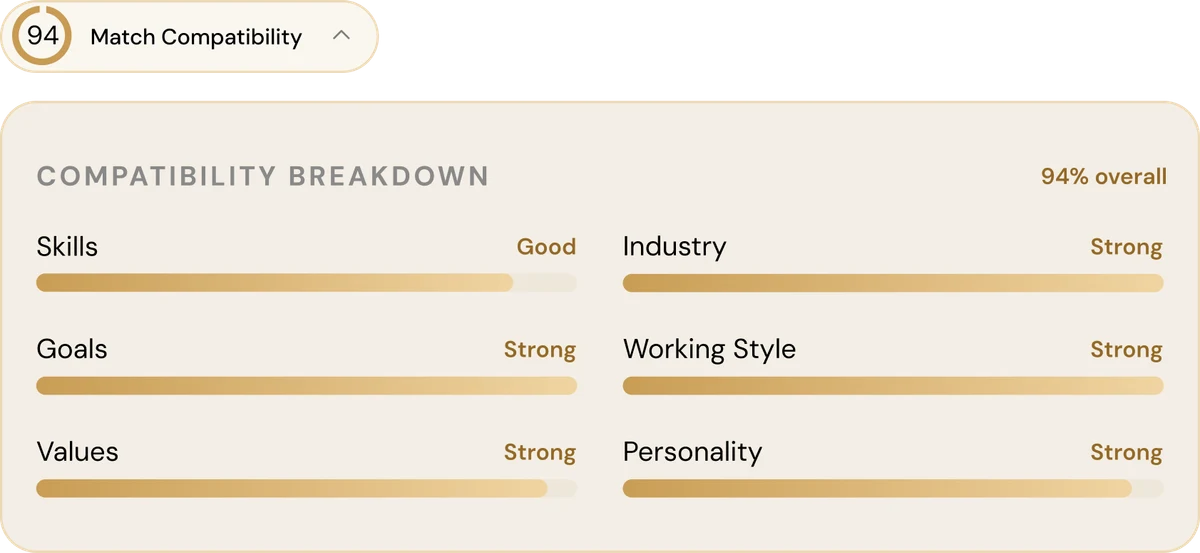
Every match shows where the two of you align and where you differ, so you can talk about the hard parts in the first call. A 10-day clock keeps each match moving, and you book the intro call in the app. Set your status to exploring and keep your job: your profile is visible only to members who are compatible with you. It's free to get started; Plus is $5 a week or $15 a month.
Once you've found someone and tested it on a small project, you can apply to YC as a team or join Antler as a complete one. Our questions to ask a potential cofounder help with the first calls.
Which should you choose?
Choose Antler if you're alone, experienced, ready to go full-time in person now, and can work legally where the residency runs. Expect most of your week in the office and about eight to ten weeks to form a team.
Choose Y Combinator if you have your team and an idea, or you're a solo founder who can build the product, and you can spend January to March (or the batch you pick) in San Francisco.
Choose neither yet if you don't have a cofounder and can't quit your job. Find your cofounder on Foundinity first, work on something small together, and apply as a team to whichever program fits then.
If you're also weighing a similar program, read Entrepreneur First vs YC and Antler vs Foundinity.
FAQ
Is Antler better than Y Combinator?
They solve different problems. Antler is for individuals who want to form a team inside a full-time residency. YC is for a founding team, or a solo founder, with an idea they want to build quickly. The better one is the one that matches where you are now.
Is Antler an accelerator?
Antler says it isn't. Its UK page answers "No" and calls Antler an inception-stage VC that runs residencies. Y Combinator is usually described as an accelerator.
Is Antler easier to get into than YC?
Neither makes it easy. Antler says it backs fewer than 1% of applicants in the UK, and about 2% are invited in Continental Europe. YC doesn't publish an acceptance rate on its FAQ or apply page. The two also judge different things: Antler judges you as a person, YC judges your company and team.
I got rejected by YC and accepted by Antler. Should I join Antler?
Join if you're ready to go full-time and in person, you don't have the cofounder you need, and you can work in that country. If you have a team and an idea you believe in, YC says about half of each batch applied more than once, so building and reapplying is a real option.
Can a solo founder get into YC?
Yes. YC's FAQ says "We regularly accept solo founders", while advising that one-person startups are tough. In the Winter 2026 batch, about 11% of companies had a solo founder, according to Extruct's count.
Can a solo founder join Antler?
Yes, and most do. Antler's UK page says most people join solo, but also that it doesn't invest in solo founders, so the aim is to form a team during the residency.
Do I need a cofounder for Y Combinator?
No, but YC recommends one, and it wants the founding team to be able to build the product themselves. For most non-technical founders, YC says that means a technical cofounder.
How long is Antler compared with YC?
Antler's UK residency is up to eight weeks for solo founders and about six for complete teams, with up to 12 more weeks if you're invited to the Investment Committee. Its US residency lasts up to three months. YC's batch is three months.
Where are Antler and YC based?
YC's batch runs in person in San Francisco. Antler runs residencies from offices in 27 cities, including London, Berlin, New York, San Francisco, Austin and Bengaluru.
Can I keep my job during Antler or YC?
You can apply to YC while employed, but YC expects you to work full-time on your company if accepted. Antler expects you to be full-time during the residency; its UK page says "This isn't a side project. No freelancing."
Do Antler and YC help with visas?
Antler's UK page asks for the right to work or a visa application by your first interview, and its US page says it doesn't sponsor visas. YC says it helps accepted founders with visas through immigration attorneys.
When is the next Antler residency and the next YC batch?
YC's next batch is Winter 2027, January to March; the on-time deadline was 2 November 2026 and late applications are still considered. Antler lists Australia from 8 February 2027, Korea and Nigeria from 15 March 2027 and Kenya from 22 March 2027, with rolling intake in the US, Canada and the Nordics. Continental Europe starts in March and September.
What happens if I don't find a cofounder at Antler?
Antler says some founders in every cohort don't make it through to investment, and you stay in its community. One London participant wrote that in 2023, team formation closed by week eight and solo participants could only join existing teams after that.
Can I find a cofounder before applying to YC or Antler?
Yes, and both reward it. YC asks you to apply when you have a founding team and an idea. Antler's complete teams start straight away. Foundinity lets you look while you keep your job.
How long does it take to find a cofounder?
Usually months. Our full answer covers what speeds it up.
Sources
- Antler UK (antler.co/location/uk), Continental Europe (antler.co/continental-europe), US (antler.co/location/us), India (antler.co/location/india), cohort start dates (antler.co/cohort-start-dates) and global FAQ (antler.co/faq), checked 10 November 2026.
- Y Combinator apply page (ycombinator.com/apply), FAQ (ycombinator.com/faq) and About page (ycombinator.com/about), checked 10 November 2026.
- Extruct, "YC W26 batch analysis", 25 March 2026.
- Jane Fisher, first-person account of Antler UK, summer 2023 cohort, HackerNoon, 5 May 2025.
- Foundinity plans and how it works: foundinity.com, checked 10 November 2026.