Compare
Entrepreneur First vs Y Combinator (2026): build a team from scratch, or bring the one you have?
Entrepreneurs First picks individuals and helps them form teams. Y Combinator picks companies that already have founders. Both end up in San Francisco. Here is how the two compare, from their own pages in November 2026.
On this page
- Side by side
- The short answer
- What Entrepreneurs First is
- What Y Combinator is
- How Entrepreneurs First works, step by step
- How Y Combinator works, step by step
- Who gets in
- Time, place and commitment
- Technical and non-technical founders
- Solo founders and cofounders
- What happens if you don't have a team
- Both lead to San Francisco
- What participants say about EF
- Who each one fits
- Foundinity: find your cofounder before you choose a program
- Which should you choose?
- FAQ
- Sources
Side by side
| Entrepreneurs First | Y Combinator | Foundinity | |
|---|---|---|---|
| What it backs | Individuals, before they have a business, cofounder or idea | Companies, from the idea stage onwards | Helps you find the cofounder |
| How it describes itself | "Talent Investing"; "We turn exceptional individuals into funded founders" | A three-month program to help startups take off | A cofounder matching platform |
| You apply as | One person; a cofounder you already have applies separately | A founding team, or a solo founder, with an idea | Yourself; no application |
| Who it looks for | People early in their careers with exceptional results; mostly technical | Founders who can build the product themselves; progress counts | Anyone looking for a cofounder |
| Length | 12 weeks forming teams in a hub city, then about 3 months in San Francisco for funded teams | 3 months | No end date; a 10-day clock on each match |
| Where | London or Bangalore, then San Francisco; US programs in San Francisco | YC's campus in San Francisco | Online, from wherever you live |
| Next start | Bangalore February 2027; London April 2027 | Winter 2027 batch, January to March | Any time |
| How teams form | Inside the cohort: you pair up, test ideas and split if it doesn't work | Before you apply; YC runs a separate matching platform | Ranked by compatibility on multiple dimensions around who you are and how you work |
| Solo founders | Everyone applies as an individual; the program is built to pair you | "We regularly accept solo founders" | Everyone starts solo |
| Feedback if rejected | US listing: "unable to provide individual feedback" | Detailed feedback after an interview | Not applicable |
| Visas | "We do not provide visas", but EF can often help with applications | Helps accepted founders through immigration attorneys | Not needed |
Below, each row in detail, with sources. We checked both programs' own pages on 10 November 2026.
The short answer
Entrepreneurs First (EF, often searched as "Entrepreneur First") and Y Combinator both back founders at the very start, and both end in San Francisco. The difference is who they pick and when.
EF picks people. It says it assesses every applicant "as individuals, before they have a business, cofounder or an idea." You move to one of its hub cities, spend 12 weeks meeting the rest of the cohort and trying out teams, and EF's Investment Committee decides which teams to back. Those teams then move to San Francisco.
YC picks companies. You apply with your founders and an idea, or a product, and if you're accepted the whole company spends three months in San Francisco. YC doesn't form teams for you inside the batch.
So: if you have no cofounder and you're early in your career, technical and free to move, EF was designed for you. If you have a team, or you can build the product alone, YC is the more direct route.
What Entrepreneurs First is
EF calls its model "Talent Investing". Its homepage says "We turn exceptional individuals into funded founders" and promises to back you first, then give you "a bridge to Silicon Valley". It says it is for people who have "continuously outperformed their peer group", have "built products, organizations or startups in the past", and have "the ambition to build a company in the U.S."
Its main programs today, from its application hub:
- London: next program from April 2027. Twelve weeks in London, then the last three months in San Francisco.
- Bangalore: next program from February 2027, for people based in India. Apply by 1 December 2026 for the third of four selection rounds.
- The Bridge Residency: an 8-week residency in San Francisco for young Europeans, with starts in February and April 2027.
- Funding and Fellowships (US): three-month residencies in San Francisco, applications reviewed on a rolling basis.
- XF2: a separate London program for people with seven or more years of experience who have founded a startup or been key to one at its start.
EF also lists EF Start, a 7-day remote challenge whose top performers are considered for its US fellowships.
What Y Combinator is
Y Combinator runs a three-month program for startups, four times a year: winter, spring, summer and fall, according to its About page. The next batch is Winter 2027. YC's apply page says it runs from January to March, in person at its San Francisco campus, opening with a three-day kick-off.
YC's FAQ says "40% of the companies we fund in each batch are just an idea" on average, so a product isn't required. A company is. YC tells you to apply "as soon as you have a founding team and an idea you are excited about", and it wants the team to be able to build the product without outsourcing it. For most businesses, it says, that means having a technical cofounder.
Inside the batch, YC splits companies into groups led by partners, with sections of 6 to 10 companies. Partners hold group office hours every two weeks and one-on-one office hours whenever founders want them. The batch ends at Demo Day. Founders keep in touch afterwards through Bookface, YC's internal platform.
How Entrepreneurs First works, step by step
1. Choose one program in one city. EF asks you to apply to only one at a time: London or a European residency if you're in Europe, Funding and Fellowships if you're in the US, Bangalore if you're in India. 2. Apply as yourself. No idea or cofounder needed. If you already have a cofounder, EF asks you to mention it and have them apply too. Applications are reviewed on a rolling basis, and EF says you'll get an email whatever the outcome. 3. Meet the Talent Investing team. If EF thinks you might fit, you're invited to meetings with them. Dylan Castillo, who joined the Berlin cohort in 2022, wrote that people he met did between one and three interviews. 4. Move to the hub. EF's London and Bangalore FAQs answer "Do I need to relocate?" with yes. EF doesn't provide visas, but says it can often help you apply. 5. Start at the Kick Off Summit. The cohort meets for the first time at a residential weekend. 6. Form a team in FORM. For 12 weeks you meet other members, pair up, test ideas and work with a Talent Investor assigned to you. 7. Pitch to the Investment Committee. Teams it funds relocate to San Francisco for LAUNCH, the final 12 weeks, ending with a Demo Day there.
How Y Combinator works, step by step
1. Apply with your company. Students and employees can apply; YC only needs you full-time if you're accepted. One application per batch. 2. Interview by video. For the winter batch, YC says most interviews happen by video call in November and December. 3. Hear back fast. YC typically decides on the day of the interview and gives interviewed founders detailed feedback, whether or not they got in. On-time Winter 2027 applicants hear by 11 December. 4. Relocate for three months. The batch is in person in San Francisco. YC says it helps founders from outside the US with visas and incorporation. 5. Build, with office hours and meetups. YC estimates program activities at a few hours a week and says every part is optional. The rest of the time goes into the company, through to Demo Day.
Who gets in
Entrepreneurs First
EF's FAQ says its programs are "most valuable for people in the early stages of their career." It calls the people it wants "outliers" and asks them to show exceptional outcomes relative to their peers. Most participants have a technical background; EF says it takes "a small number of non-technical individuals who demonstrate solid technical understanding." If you have seven or more years of experience, EF points you to XF2 instead.
EF doesn't publish an acceptance rate in its FAQ, and neither do we.
Y Combinator
YC doesn't publish an acceptance rate on its apply page or FAQ either. It says a few things that help you judge your chances:
- About half the companies in a typical batch applied more than once before getting in.
- Progress since your last application is "a strong signal".
- You don't need to know anyone at YC; it calls considering all applications equally a core principle.
YC looks at the company and the team together. EF looks at you, alone, and bets that you'll find a team.
Time, place and commitment
Where you have to be
Both programs are full-time and in person, and both end in San Francisco, but the path differs.
At EF, you move twice if you're funded: first to London or Bangalore for 12 weeks of FORM, then to San Francisco for LAUNCH. EF's FAQ says it expects you to "commit full-time to the program, and move to one of our hub cities". The London listing on its application hub says you move after 12 weeks; the Bangalore listing for February 2027 says after 14.
At YC, you move once: to San Francisco for the three-month batch. After the batch, YC's FAQ says you can go wherever you want.
Timing
| Entrepreneurs First | Y Combinator | |
|---|---|---|
| Next start | Bangalore: February 2027 (apply by 1 December 2026 for round three of four). London: April 2027. Bridge Residency: February and April 2027 | Winter 2027: January to March |
| How often | Set cohorts in London and Bangalore; rolling in the US | Four batches a year |
| Deadlines | Rolling review | Winter 2027 on-time deadline was 2 November 2026; late applications still considered; Early Decision for later batches |
| Total time | 12 weeks, plus about 3 months in San Francisco if funded | 3 months |
What it asks of your week
EF expects your full time throughout. Castillo wrote that most of his cohort had recently quit a job or finished studying before joining.
YC expects you to work full-time on your company for the batch and afterwards. The scheduled program itself is light: a kick-off, office hours and weekly meetups, which YC estimates at a few hours a week.
Technical and non-technical founders
Both programs lean technical, for different reasons.
EF says most of its participants have a technical background and it takes a small number of non-technical people. Dan MacDonald, a commercial founder in EF's Toronto cohort in 2022, wrote that the program then required one commercial and one technical cofounder per team. So a non-technical applicant competes for a limited number of places, and then needs a technical partner from the same room.
YC asks that the founding team can build the product itself. A non-technical solo founder can apply, but YC's FAQ says most businesses need a technical cofounder. If that's you, our guide to finding a technical cofounder covers where to look before you apply.
Solo founders and cofounders
At EF, everyone starts alone. The application is individual, even if you already have a cofounder. The program exists to pair people up. Castillo described the ideation sessions as "a sort of speed-dating event for entrepreneurs" and tried three teams. Alexander Smirnov, who joined the London cohort in 2024, counted about 60 people and described teams being scored from 1 to 4 in the second month on their chances at the Investment Committee.
At YC, you can be alone, but you're the exception. The FAQ says "We regularly accept solo founders" and in the same answer that one-person startups are tough. Extruct's count of the Winter 2026 batch found 22 solo founders among 199 companies, about 11%, while 129 companies (64%) had exactly two cofounders. YC doesn't pair people inside the batch; it runs a separate, free cofounder matching platform, compared in YC cofounder matching vs Foundinity.
What happens if you don't have a team
At EF, the team has to form inside the program. Castillo wrote that in his 2022 Berlin cohort, anyone not on a team after the first eight weeks had to leave. He counted 49 teams formed over the program and 13 that presented to the Investment Committee. Smirnov wrote in 2024 that you can bring in a cofounder from outside, who then goes through the same interviews. EF's FAQ also lists internal hiring: you can join another EF startup as an early hire. It doesn't say what happens to members who end FORM without a team.
At YC, there's no team-forming phase to fail. You either apply as a solo founder or find someone first. The risk shifts: you aren't cut for being unpaired, but nobody pairs you either.
Both lead to San Francisco
This is easy to miss. EF's homepage says it is for people who want to build a company in the US, and its funded teams spend the last three months in San Francisco, ending with a Demo Day there. YC's batch happens in San Francisco from the first day.
If you don't want to build a US company, think about whether either program fits your plans. If you do, the question becomes whether you want EF to help you find a cofounder on the way, or whether you arrive at YC with one.
What participants say about EF
First-person accounts of EF are mixed, and most praise the people while questioning parts of the process:
- Castillo (Berlin, 2022) liked the people and the push to talk to customers, disliked the meeting load and the feeling of being graded, and said he would do it again.
- MacDonald (Toronto, 2022) called EF possibly the best place to find a cofounder if you want to start a venture-backed deep tech startup, and found partner advice inconsistent. He also wrote that EF "was not optimizing for my individual success".
- Smirnov (London, 2024) valued being surrounded by people his age doing the same thing, and described the team-building phase as a "love island".
These are single accounts from single cohorts. EF no longer lists Berlin or Toronto on its application hub.
Who each one fits
Entrepreneurs First fits you if:
- you're early in your career, with results that stand out against your peers;
- you're technical, or non-technical with real technical understanding;
- you don't have a cofounder and can move to London or Bangalore for 12 weeks, then possibly San Francisco;
- you want to build a venture-backed company in the US.
Y Combinator fits you if:
- you have a founding team, or you can build the product yourself;
- you're committed to an idea and can show progress;
- you can be in San Francisco for three months;
- you're ready to reapply if the first answer is no.
Neither fits yet if you don't have a cofounder and can't leave your job or move country right now. That describes a lot of people who search this question.

Foundinity: find your cofounder before you choose a program
EF builds its program around forming teams under time pressure, and YC builds its application around the team you already have. Either way, the cofounder is the part that decides most. Foundinity lets you find that person first, without applying, moving or quitting.
You state what you need in a cofounder, and answer an assessment about how you work: commitment, working style, ambition, personality, goals, values, alongside your skills and interests. A multi-trait algorithm built on established psychological compatibility models ranks who you see, so you start with compatible people, not hundreds of random profiles. Skills tell you who can do the job. The rest tells you who you can actually build with for years.
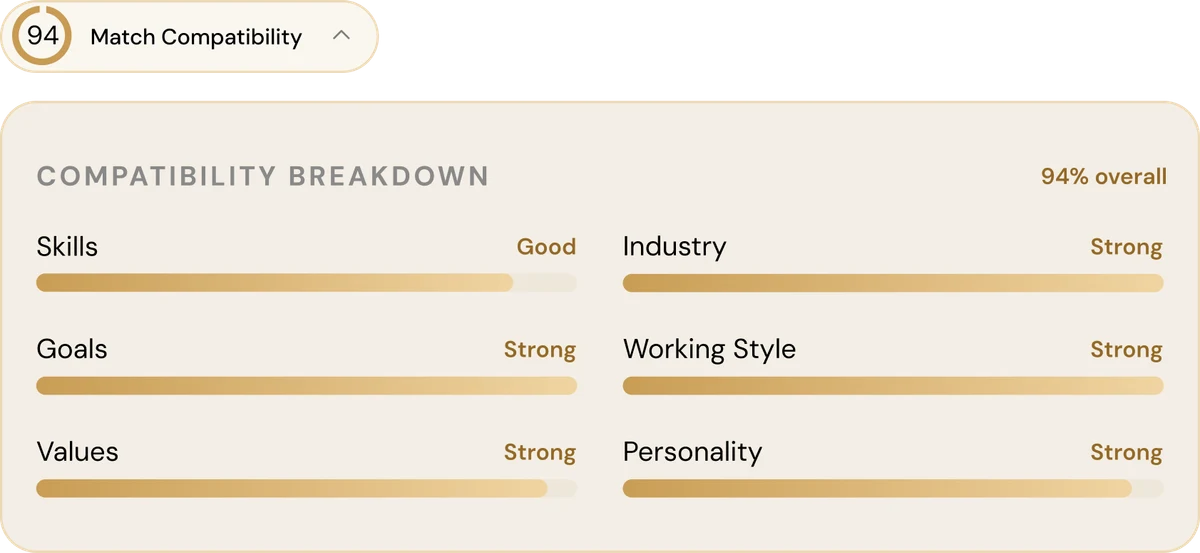
Every match shows where the two of you align and where you differ. If your goals or ambition differ, you see it before the first call, which matters when one program would mean moving to another country. A 10-day clock keeps each match moving, and you book the intro call in the app. If you're employed, set your status to exploring: only compatible members can see your profile. It's free to get started; Plus is $5 a week or $15 a month.
When you've found someone and worked on something small together, you can apply to YC as a team, or to EF as a pair (EF asks both of you to apply). For the first conversations, use our questions to ask a potential cofounder.
Which should you choose?
Choose Entrepreneurs First if you have no cofounder, you're early in your career and technical, you can move now, and you want EF to build the team around you. Expect to be paired and re-paired against a deadline.
Choose Y Combinator if you already have your cofounder, or you're a solo founder who can build, and you want three months in San Francisco focused on one company.
Choose neither yet if you can't leave your job or move, or you're past EF's early-career focus. Find a cofounder on Foundinity first, test how you work together, and apply as a team when you're ready.
For the other program people compare with YC, see Antler vs YC. For EF against a matching platform, see Entrepreneur First vs Foundinity.
FAQ
Is Entrepreneur First better than Y Combinator?
They are built for different starting points. EF is for individuals without a team who are early in their careers and willing to move. YC is for a company that already has its founders. Pick the one that matches where you are.
Is Entrepreneur First an accelerator?
EF describes its model as "Talent Investing": it backs individuals before they have a team or idea. Y Combinator is the program most people mean by "accelerator", and it backs companies.
Do I need a cofounder for Entrepreneur First?
No. EF's FAQ says you need neither a cofounder nor an idea. If you have a cofounder already, mention it and ask them to submit their own application.
Do I need a cofounder for Y Combinator?
No. YC regularly accepts solo founders, but it advises having a cofounder and wants the team to be able to build the product itself.
Can a solo founder get into YC?
Yes. Extruct counted 22 solo founders among 199 companies in the Winter 2026 batch, about 11%.
Is Entrepreneur First only for technical people?
Mostly. EF says most participants have a technical background and it takes a small number of non-technical people who show solid technical understanding.
How long is Entrepreneur First compared with YC?
EF's FORM phase is 12 weeks in London or Bangalore, and funded teams spend about three more months in San Francisco. YC's batch is three months.
Do I have to move for Entrepreneur First or YC?
For both, yes. EF asks you to move to a hub city, and funded teams move again to San Francisco. YC's batch is in person in San Francisco.
When is the next Entrepreneur First program and YC batch?
EF lists Bangalore from February 2027 (apply by 1 December 2026 for the third selection round) and London from April 2027. YC's next batch is Winter 2027, January to March; the on-time deadline was 2 November 2026 and late applications are still considered.
What happens if I don't find a cofounder at Entrepreneur First?
EF's FAQ doesn't say. One participant wrote that in his 2022 Berlin cohort, people without a team after eight weeks had to leave. EF's FAQ mentions internal hiring, where you join another EF startup as an early hire.
Does Entrepreneur First give feedback if you're rejected?
Its US listing says it is "unable to provide individual feedback". YC gives detailed feedback to everyone it interviews, accepted or not.
Can I apply to Entrepreneur First with experience?
EF's main programs focus on people early in their careers. For seven or more years of experience and a startup behind you, it points to XF2 in London.
Can I apply to Entrepreneur First and YC at the same time?
Neither FAQ addresses it, and they suit different situations: EF wants you as an individual before you have a team, YC wants the company you've formed. If you have a cofounder and an idea already, YC is the natural fit.
Can I find a cofounder before applying to EF or YC?
Yes. EF asks existing cofounders to both apply. YC asks you to apply once you have a founding team. Foundinity lets you look while you keep your job.
How long does it take to find a cofounder?
Usually months. Our full answer covers what speeds it up.
Sources
- Entrepreneurs First homepage (joinef.com), FAQs (joinef.com/faqs, joinef.com/faqs/london, joinef.com/faqs/bangalore) and application hub (apply.joinef.com), checked 10 November 2026.
- Y Combinator apply page (ycombinator.com/apply), FAQ (ycombinator.com/faq) and About page (ycombinator.com/about), checked 10 November 2026.
- Extruct, "YC W26 batch analysis", 25 March 2026.
- Dylan Castillo, "My Experience at Entrepreneur First", 20 January 2023.
- Dan MacDonald, "Is Entrepreneur First Worth It? Part 4: My Brutally Honest Review of the Program", 8 May 2023.
- Alexander Smirnov, "Is Entrepreneur First worth the time?", 2024.
- Foundinity plans and how it works: foundinity.com, checked 10 November 2026.