Compare
CoFoundersLab vs YC cofounder matching: which one is better for finding a cofounder?
One is a member network with a paid Premium plan, running since 2011. The other needs approval first and caps your invites each week. Here's how they compare, and where to look if neither fits.

On this page
- Side by side
- What CoFoundersLab is
- What YC cofounder matching is
- How each one works, step by step
- Getting in: open sign-up vs approval
- Cost and billing
- Who's on each platform
- Reaching out: messages vs invites
- Privacy: who can see your profile
- What users report
- Who each one fits
- Foundinity: start from how you work
- Which should you choose?
- FAQ
- Sources
Side by side
| CoFoundersLab | YC cofounder matching | Foundinity | |
|---|---|---|---|
| Who runs it | An independent company; site launched November 2011 | Y Combinator, as part of Startup School; launched 2021 | Foundinity |
| Cost | Free account; Premium $29 a month after a 30-day trial | Free | Free to get started; Plus $5 a week or $15 a month |
| Getting in | Sign up and fill in a profile | Profile reviewed first; Startup School says approval "may take up to a week" | Sign up and take the assessment |
| How you find people | Search the member base yourself | Read the profiles the platform suggests, one at a time, and pick who to invite | Ranked by compatibility on multiple dimensions around who you are and how you work |
| First contact | Direct messages | Invites, capped each week; an accepted invite is a match | A mutual like is a match |
| Who sees your profile | "Fully visible to all Members and customers", per its privacy policy | Only approved members; not public to the internet | Only members who are compatible with you |
| Rules on members | None described in its terms | Removal for hiring, selling, going quiet after a match, contacting people elsewhere without permission, harassment | Profiles shown only to compatible members; 10-day clock on every match |
The rest of this page goes through each row: what the two platforms are, how they work, what each costs, who you'll meet, how they handle privacy and safety, and what people who used them have written. Then we cover where Foundinity fits and which of the three to use.
What CoFoundersLab is
CoFoundersLab is one of the oldest cofounder sites still running. According to TechCrunch, it launched in November 2011 out of The Fort, a Washington, D.C. tech accelerator, and in 2012 it bought two smaller cofounder sites, TechCofounder.com and FounderMatchup.com.
Today it works like a member directory. You create a free account, write a profile, search the other members yourself and message the ones you choose. The homepage also promotes advice from industry figures, pitch preparation and access to investors. A Premium plan sits on top of the free account.
What YC cofounder matching is
YC's cofounder matching is a free platform that Y Combinator runs as part of Startup School, its online programme for founders. It opened in 2021. You don't have to apply to YC's accelerator or be in a batch to use it. Its page says it's for "Anyone who is looking for a co-founder", with or without an idea, and Startup School's FAQ narrows that to "Anyone who is seriously looking".
The platform is built around approval and invites. Your profile is reviewed before you can use it. After that, the platform shows you member profiles one at a time, and you invite the people you want to talk to. If they accept, you're matched and can set up a call. YC also runs in-person cofounder matching meetups in San Francisco and New York.
How each one works, step by step
On CoFoundersLab
1. Sign up for a free account and fill in your profile: what you're building, your skills and what you're looking for. 2. Search the member base and open profiles that look relevant. 3. Message the people you want to reach. The Premium page marks the free plan "Limited" and Premium "Unlimited" across searching, messaging and video chat, without publishing the free limits. 4. To get Premium extras such as recommended candidates and seeing who viewed your profile, start the 30-day trial. It moves to $29 a month unless you cancel before the renewal date. 5. Arrange calls and follow-ups yourself.
On YC cofounder matching
1. Create a profile. Startup School asks about your education, your employment and what you want in a cofounder. 2. Wait for approval. The FAQ says this may take up to a week. 3. Read the profiles the platform puts in front of you, one at a time, and send invites within the weekly cap. 4. When someone accepts, you're matched. Startup School tells you to set up a video call "ASAP". 5. If the call goes well, it recommends a trial project and "2-4 weeks of close work" before you commit to anything.
Getting in: open sign-up vs approval
On CoFoundersLab there's no gate. Anyone can make an account, and nothing in its terms describes a check on who joins. The terms go further and say the company does "not warrant the accuracy, completeness, or usefulness" of the information on the site.
YC reviews every profile before it goes live. Startup School's FAQ says approval "may take up to a week". It can take longer: in an August 2025 Hacker News post titled "Co-Founder Matching profile in review for over a month", a user asked how long acceptance usually takes. The only reply suggested emailing YC.
Approval doesn't verify identity, though. In September 2026 another Hacker News user posted "Beware: Malicious Profiles on YC Co-Founder Matching" after a match with someone whose profile photo, on a reverse image search, belonged to a different person. That match wanted to move to WhatsApp straight away and refused a voice or video call. The user reported it to YC.
So YC reviews profiles at sign-up and CoFoundersLab doesn't describe a check, but neither verifies identity. On both, checking that a person is who they say they are is your job.
Cost and billing
YC's cofounder matching costs nothing. Its page says it is "a completely free product", and Startup School's FAQ says the same of Startup School as a whole. There's no paid tier.
CoFoundersLab has a free account and a Premium plan at $29 a month, with a 30-day free trial. The Premium page shows a monthly and an annual option but listed no annual price when we checked. The billing terms are where people get caught out:
- After the 30-day trial, the terms say "you consent to automatic payments or debit on your credit card".
- The card is charged "at the start of each subscription period".
- "To avoid future charges, cancel before the renewal date."
- CoFoundersLab "may store and continue billing your payment method (e.g. credit card) even after it has expired".
- On refunds, the terms point you to your bank, under your agreement with it.
If you try the trial, put the renewal date in your calendar the day you start it, cancel a few days early and keep the confirmation email.
Who's on each platform
Neither platform publishes current, independently checked member numbers, so we don't quote any. What you can go on is who each one says it's for, and what members report.
CoFoundersLab's homepage is aimed at entrepreneurs looking for a business partner, and nothing on its pages sets a condition on who can join. Its homepage also courts people who want advice, pitch help and investor contacts, so not everyone you find there is looking for a cofounder right now.
YC's page says its platform is for "Anyone who is looking for a co-founder", with or without an idea, and for people already building a startup as well as those only curious about one. Startup School's FAQ narrows that to people who are "seriously looking", and lists hiring and selling as reasons for removal. YC also runs in-person meetups in San Francisco and New York, which favours members in those two cities.
Inactive accounts are a question on both. Trustpilot reviewers describe struggling to delete their CoFoundersLab profiles, so old accounts can linger in search results. On YC's platform, the 2023 Hacker News thread covered below complained about members who browse without meaning to start anything. A big pool tells you little about how many people are actively looking this month.
Reaching out: messages vs invites
On CoFoundersLab you message people directly. Nothing stops you messaging anyone, and nothing stops anyone messaging you. That cuts both ways: you can reach people fast, and so can recruiters, service sellers and fake accounts. Fake and impersonating profiles and suspicious connection requests are among the complaints on its Trustpilot page.
On YC's platform you send an invite, and a conversation opens only if the other person accepts. Invites are capped each week, so you have to choose who gets one from profiles alone, and an invite that isn't accepted simply sits there with no reason given.
YC also sets rules for what happens after a match. Startup School can remove members for "Being unresponsive when trying to schedule a time to meet after matching", for using the platform to hire or sell, for contacting someone on another platform such as LinkedIn without permission, and for harassment. CoFoundersLab's terms describe no equivalent rules about how members treat each other.
Privacy: who can see your profile
If you're still employed, this part matters.
CoFoundersLab's privacy policy says: "Your profile is fully visible to all Members and customers of our Services." It adds that, depending on your settings, it "can also be visible to others on or off of our Services", naming visitors and "users of third-party search engines". After you close your account, the policy says your profile may still appear in search engine results "until they refresh their cache".
YC says your profile is "not public to the internet". It's visible only to members who have been approved for cofounder matching, and the page says employers can't find you there.
On CoFoundersLab, check your visibility settings before you write anything in your profile. On either platform, every member who can see you can read what you write, so keep out details your employer would recognise.
What users report
CoFoundersLab
The public record is poor. On Trustpilot it scores 1.3 from 107 reviews, 94% of them one star, with 32 written in the last 12 months and the newest dated 28 October 2026. The profile is unclaimed. The recurring complaints are marketing emails people can't unsubscribe from, accounts and data that are hard to delete, fake profiles, support that doesn't answer, slow pages and notifications that don't arrive, and trouble cancelling.
The Better Business Bureau rates it F. It lists 21 complaints in the last three years, 8 in the last twelve months, all marked unanswered; most are about cancelling, deleting accounts, unwanted email and unexpected charges. On Reddit, a July 2025 r/Entrepreneur thread is titled "Shady subscription billing by Cofunders lab, refuses to cancel trial, keeps charging my card".
YC cofounder matching
YC's platform has no Trustpilot or BBB profile, so feedback comes from threads and write-ups. The best-known is "Ask HN: YC co-founder matching is bad" from February 2023, with 88 points and 101 comments. The complaints there: profiles come one at a time, with no way to search by skill or idea, and many members are browsers who like the idea of a startup more than they want to start one. Commenters called them "lurkers" and "shoppers".
Abbianca Makoni, writing for POCIT in August 2022, tried YC's platform and found sign-up quick. Her concern was that it doesn't take the vetting off your hands: references aren't asked for, and someone who looks right on paper can be wrong in person.
Someone who used both
Avinash Saravanan's review of both platforms from March 2022 is the only first-hand comparison we found. On CoFoundersLab he described a weekly cap on searches for free members, inactive profiles in search results, email notifications that stopped arriving and promotional emails he couldn't unsubscribe from. On YC's platform he used the invite system and noted it had no built-in video chat, so calls had to be set up elsewhere. It's one person's experience from 2022, but several of his CoFoundersLab points match the 2026 Trustpilot themes.
Who each one fits
YC cofounder matching fits you if you can wait for approval, you're happy to read profiles one at a time and pick who to invite within a weekly cap, and you can reply quickly once matched, since members who go quiet can be removed. Members in or near San Francisco and New York can also go to its in-person meetups.
CoFoundersLab fits you if you want to message people directly without waiting for an invite to be accepted, and you're comfortable with a profile every member can see. If you try Premium, treat the trial terms as the main risk and cancel early.
Neither fits well if you want to know how someone works before you spend evenings on calls. Both platforms show you a profile, and both leave judging fit to you.

Foundinity: start from how you work
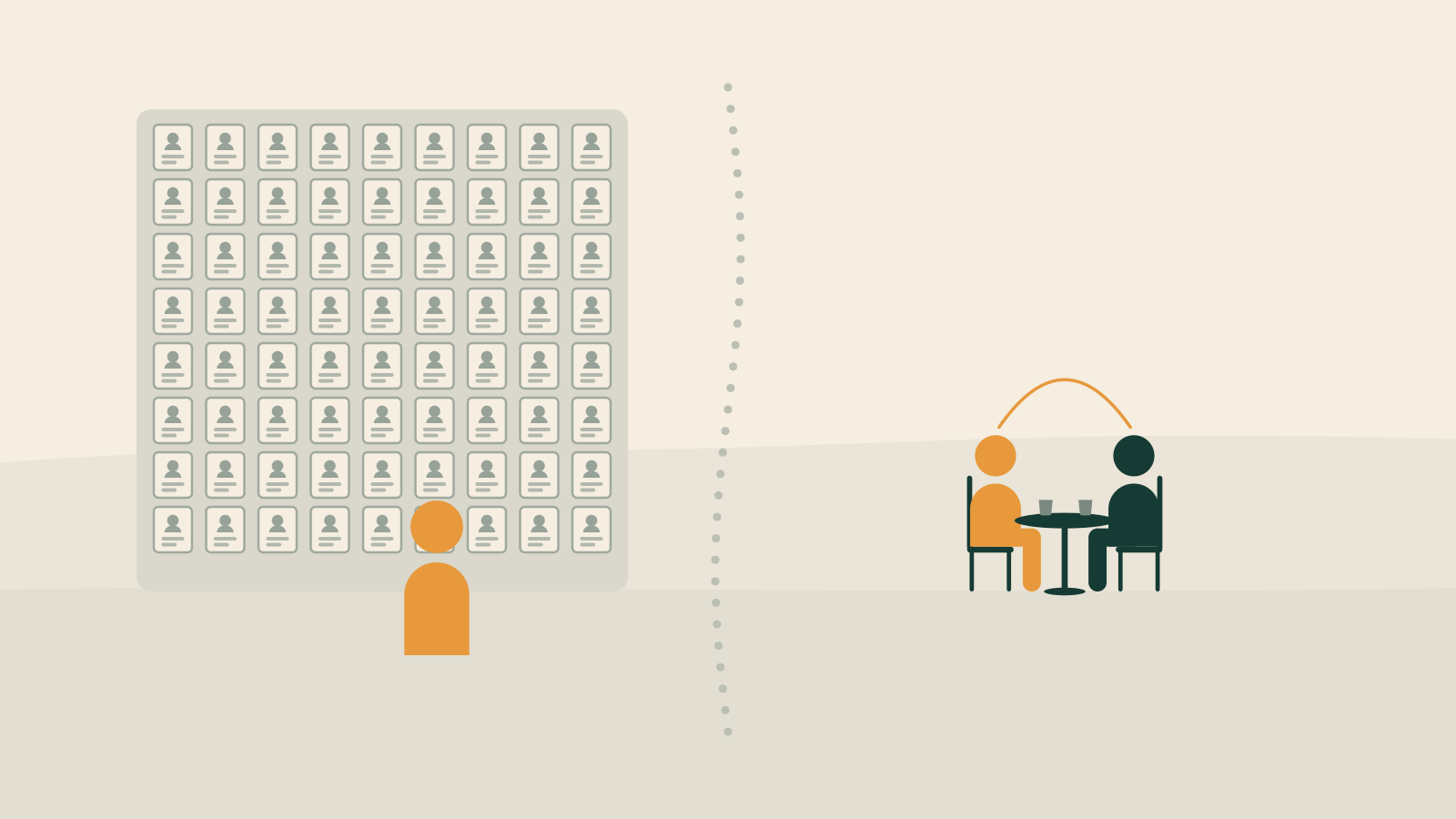
Both platforms start from profiles. Foundinity starts from how you work. You state what you need in a cofounder, and answer an assessment about how you work: commitment, working style, ambition, personality, goals, values, alongside your skills and interests. A multi-trait algorithm built on established psychological compatibility models ranks the people you see, so you start with compatible people instead of hundreds of random profiles.
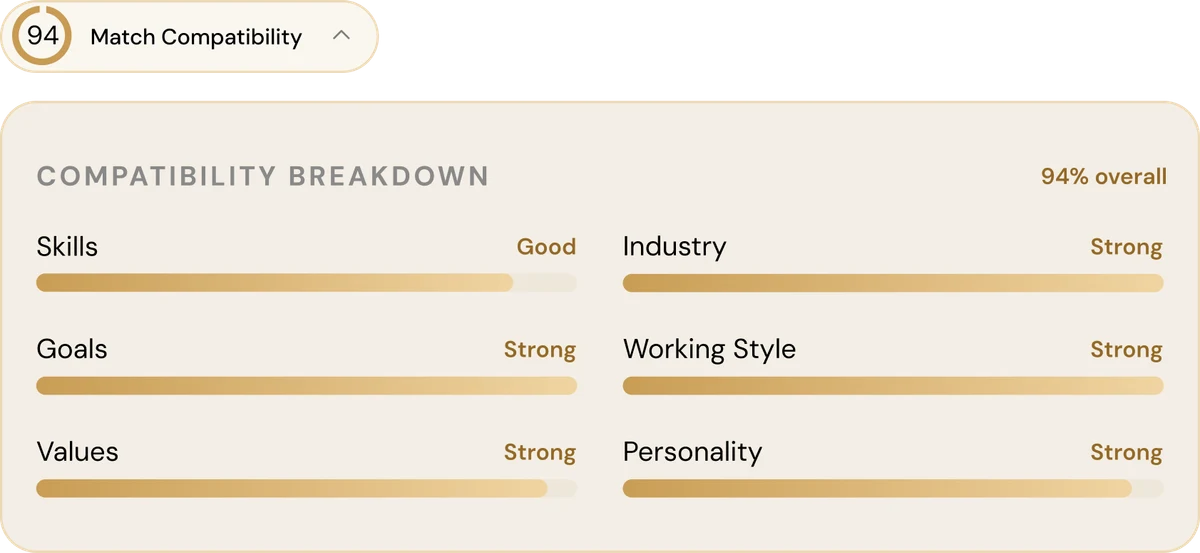
When you and someone else both like each other, it's a match. Every match comes with a compatibility breakdown showing where you align and where you differ, so the first call starts with what matters. A 10-day clock keeps the match from going quiet, and you book the intro call in the app. Your profile is visible only to members who are compatible with you, and an exploring status lets you look while you're still employed. It's free to get started; Plus is $5 a week or $15 a month. More on how it works.
Which should you choose?
Set side by side, the two differ in how you get in and who sees you. CoFoundersLab lets anyone in straight away, shows your profile to every member, and puts its extras behind a Premium plan whose trial bills automatically; its reviews average 1.3 out of 5. YC's platform makes you wait for approval, limits your invites each week and can remove you for going quiet after a match. Decide on those terms: do you need to start today, are you fine with every member seeing your profile, and have you read the billing terms before adding a card?
What they share matters more. On both, you search or scroll the profiles, decide who might fit, and find out on the calls whether you were right. If that's the part you want help with, start with Foundinity: people arrive ranked by compatibility, and every match shows where you align and differ before you talk. You can use more than one platform at a time.
Whichever you use, check the person: look them up outside the platform, get on video early, ask the questions in our guide to questions to ask a potential cofounder, and work on something small together before you commit.
FAQ
Is CoFoundersLab better than YC cofounder matching?
They're built differently. CoFoundersLab has open sign-up, a $29-a-month Premium plan after a 30-day trial that bills automatically, profiles visible to all members and a 1.3 Trustpilot score. YC's platform needs approval first, caps invites each week and removes members who are unresponsive after a match. On both, you judge fit yourself from profiles.
Is YC cofounder matching free?
Yes. YC calls it "a completely free product", and there's no paid tier.
Is CoFoundersLab free?
It has a free account with limits that aren't published. Premium costs $29 a month after a 30-day free trial, and the trial turns into automatic monthly payments unless you cancel before the renewal date.
How many invites can you send on YC cofounder matching?
YC's cofounder matching allows 20 invites a week. A conversation opens only when the other person accepts.
How long does YC cofounder matching approval take?
Startup School's FAQ says up to a week. Some users report waiting longer; one Hacker News post from August 2025 describes a profile in review for over a month.
Do I need to be in Y Combinator to use its cofounder matching?
No. It's open to anyone looking for a cofounder, and you don't have to apply to YC's accelerator.
Can I use CoFoundersLab and YC cofounder matching at the same time?
Yes. Nothing in either platform's rules stops it. YC's rules do say you shouldn't contact a member on another platform without their permission.
Can my employer see my profile?
On YC's platform, the page says no: profiles aren't public and employers can't find you. On CoFoundersLab, profiles are visible to all members, and depending on your settings, possibly to visitors and search engines.
Does CoFoundersLab verify its members?
Its terms don't describe any checks, and they say the company doesn't warrant the accuracy of information on the site. Fake profiles are a recurring Trustpilot complaint.
Does YC verify the people on its cofounder matching platform?
It approves profiles before they go live and removes members who break its rules, but approval isn't an identity check. A September 2026 Hacker News post described a match using someone else's photo.
How do I cancel CoFoundersLab Premium?
Cancel before the renewal date, as the terms require, and keep the confirmation. Don't rely on an expired card to stop charges: the terms say CoFoundersLab may keep billing it. If a charge appears after you cancelled, contact your card issuer.
Which has more people, CoFoundersLab or YC?
Neither publishes current, independently checked figures, and any total counts accounts of every age, active or not. How many people reply to you matters more than how many profiles exist.
What is the success rate of YC cofounder matching?
Neither platform publishes one, and neither reports how many matches turn into companies.
Is there an alternative to both?
Foundinity works differently from both: instead of reading profiles, you answer an assessment about how you work and see people ranked by compatibility, with a compatibility breakdown and a 10-day clock on every match. See also our list of YC cofounder matching alternatives and CoFoundersLab alternatives.
How long does it take to find a cofounder online?
Usually months, whichever platform you use. Our article on how long it takes to find a cofounder covers what makes it faster.
Sources
- CoFoundersLab homepage, Premium page, terms and privacy policy (cofounderslab.com, cofounderslab.com/premium, cofounderslab.com/terms, cofounderslab.com/privacy), checked 10 November 2026.
- Y Combinator cofounder matching page (ycombinator.com/cofounder-matching) and Startup School FAQ (startupschool.org/faq), checked 10 November 2026.
- TechCrunch, on CoFoundersLab's launch and acquisitions, 28 June 2012.
- Trustpilot, CoFoundersLab reviews, checked 10 November 2026.
- Better Business Bureau, CoFoundersLab profile, checked 10 November 2026.
- Reddit, r/Entrepreneur, "Shady subscription billing by Cofunders lab, refuses to cancel trial, keeps charging my card", July 2025 (thread title).
- Hacker News: "Ask HN: YC co-founder matching is bad" (news.ycombinator.com/item?id=34883106), 21 February 2023; "Co-Founder Matching profile in review for over a month" (item?id=45030584), 26 August 2025; "Beware: Malicious Profiles on YC Co-Founder Matching" (item?id=49552237), September 2026; all checked 10 November 2026.
- Abbianca Makoni, "Can POC founders find good and reliable cofounders on a matchmaking platform?", POCIT, 20 August 2022.
- Avinash Saravanan, "My Experience with CofoundersLab and YCombinator Cofounder Matching: A Review", Medium, March 2022.
- Foundinity plans and how it works: foundinity.com, checked 10 November 2026.