Compare
Founder2be alternatives: where to find a cofounder now that it's offline
Founder2be's website doesn't load any more. If you're still searching for it, these are the places to look for a cofounder instead.

On this page
What happened to Founder2be
On 8 November 2026, founder2be.com and www.founder2be.com didn't resolve: the domain returned no address, both in a browser and from the command line. There is no site to log in to, and no profiles or messages to reach.
The Wayback Machine holds copies of the site going back to February 2011. In its last full copy of the homepage, from December 2020, Founder2be described itself as a free place to find a cofounder: you signed up, completed a profile, and looked for tech cofounders, developers, designers and marketers, with sections for cofounder profiles and ideas. A later archived capture from January 2022 shows a goodbye page on the site, which says Founder2be shut down on 31 December 2020.
People still search for Founder2be, and for "founder2be vs cofounderslab". If that's how you got here, the rest of this page covers where to look now.
If you had a Founder2be profile
With the domain offline, there's nothing to recover from the site itself. If you were talking to someone you met there, look them up on LinkedIn or search for their name and project, and pick the conversation up directly.
For a fresh search, write down three things before you sign up anywhere new: the skills you need, the hours you can give each week, and what kind of company you want to build. The last two matter as much as the first, and they're the things a bare profile rarely shows.
Founder2be vs CoFoundersLab
The question has a short answer now: Founder2be is offline, and CoFoundersLab is still running. If you're weighing CoFoundersLab as the replacement, know these facts first.
CoFoundersLab is a membership site where you search member profiles and message people yourself. Premium costs $29 a month after a 30-day free trial. Its terms say that after the trial "you consent to automatic payments", that it may keep billing a card "even after it has expired", and that to avoid future charges you need to "cancel before the renewal date". The same terms say it doesn't "warrant the accuracy, completeness, or usefulness" of information on the site.
On Trustpilot, CoFoundersLab has a TrustScore of 1.3 from 107 reviews, and 94% of them are one star (checked 8 November 2026). The profile is unclaimed. Our CoFoundersLab vs Foundinity page goes through it row by row.
The options at a glance
| Option | Cost to start | How you find people | What's left to you |
|---|---|---|---|
 Foundinity | Free; Plus $5 a week or $15 a month | Ranked by compatibility on multiple dimensions around who you are and how you work | Like the people you want to meet, then book the intro call in the app |
| YC's cofounder matching | Free | Browse approved profiles; up to 20 invites a week | Sorting profiles, judging fit, following up |
| CoFoundersLab | Free plan; Premium $29 a month after a trial | Search member profiles | Searching, messaging, checking who's real, cancelling on time |
| Founder Institute events | No fee listed | Online cofounder networking events | Working out who's serious, following up |
| Startup Weekend and hackathons | Set by each event | Form a team over a weekend | Getting there, following up afterwards |
| Indie Hackers | Free | Forum posts | Writing the post, waiting, reaching out |
| Free; InMail needs Premium | Search people's work history | Finding who's open to it, getting introductions | |
| Entrepreneur First, Antler | Selective; full-time | Cohorts where teams form | Getting in, leaving your job |
Foundinity: matched on how you work
Foundinity is a cofounder matching platform. You state what you need in a cofounder, and answer an assessment about how you work: commitment, working style, ambition, personality, goals, values, alongside your skills and interests. A multi-trait algorithm built on established psychological compatibility models ranks the people you see, so you're looking at compatible people instead of scrolling through hundreds of random profiles.
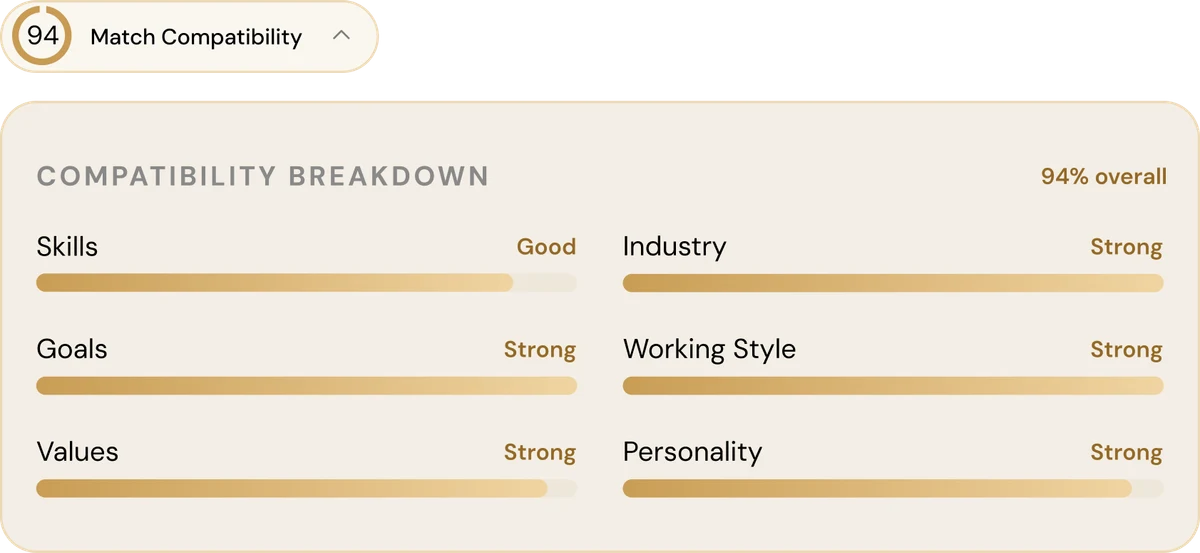
Every match shows a compatibility breakdown: where you align and where you differ, so you know what to talk about on the first call. When you and someone else both like each other, it's a match, and a 10-day clock starts so the conversation doesn't sit unanswered. You book the intro call inside the app. Your profile isn't public; only members who are compatible with you can see it. If you aren't ready to commit yet, set your status to exploring and meet people at your own pace.
How it works.
1. Sign up and say what you need in a cofounder. 2. Take the assessment about how you work. 3. Open the app to people ranked by compatibility. 4. Like the people you want to meet. A mutual like is a match. 5. Read the compatibility breakdown and book the intro call before the 10-day clock runs out.
What it costs. Free to get started: 5 likes a week, up to 3 active matches and up to 3 profile saves. Plus costs $5 a week or $15 a month (₹300 or ₹1,000 in India) and adds 15 likes a week, unlimited active matches, a list of everyone who liked you and up to 5 profile saves.
Who it's for. Anyone looking for a cofounder who wants to find out early whether someone will work the way they do. Skills tell you who can do the job. The rest tells you who you can actually build with for years. More on how it works and pricing.
Other options
1. YC's cofounder matching
What it is. A free directory of founder profiles run by Y Combinator as part of Startup School. You write a profile, wait for approval, then browse other approved profiles and invite the people you want to talk to. When someone accepts, it's a match and you arrange a call.
What to know. Startup School's FAQ says approval "may take up to a week". Invites are capped at 20 a week, and sorting through profiles and judging fit is up to you. The FAQ also lists being unresponsive after matching, and contacting members on another platform without their permission, among the reasons a member can be removed.
Where Foundinity differs. There's no approval queue. Foundinity asks how you work, ranks people by compatibility, and shows where the two of you align and differ before the first call. More in YC cofounder matching vs Foundinity.
2. CoFoundersLab
What it is. A membership site of founder profiles that you search and message yourself.
What to know. Premium is $29 a month after a 30-day trial that turns into automatic payments unless you cancel before the renewal date. Its Trustpilot score is 1.3 from 107 reviews, with complaints about spam, fake profiles and trouble cancelling.
Where Foundinity differs. Plus has a $5 weekly option, and you don't need it to start: you can take the assessment, match and talk on the free plan.
3. Founder Institute's online cofounder events
What it is. Virtual cofounder networking events that Founder Institute says are open to anyone.
What to know. Its find-a-cofounder page lists no fee for the events. The same page's programme FAQ says Founder Institute doesn't make guarantees about finding a cofounder. The events are for meeting people; any follow-up is up to you.
Where Foundinity differs. An hour of networking tells you little about how someone works. On Foundinity, the compatibility breakdown shows that before you spend time on a call.
4. Startup Weekend and hackathons
What it is. Techstars Startup Weekend is a three-day event, billed as building a startup in 54 hours: people pitch ideas, form teams and work toward a launch. Hackathons run on a similar clock, with more of the time spent writing code.
What to know. Events run on fixed dates in particular cities, so you go when one fits your calendar. A weekend shows how someone handles a deadline; it says less about how they'll hold up over months.
With Foundinity. A weekend makes a good trial once you've found someone. Match on Foundinity, then enter an event together and see how you work under pressure.
5. Indie Hackers
What it is. A free forum where founders post about what they're building.
What to know. There's no cofounder feature. Indie Hackers retired its "Looking to Partner Up" group and its site search in 2026, so a partner request is an ordinary post in the main feed, and older requests can only be found through a web search.
Where Foundinity differs. Replies on a forum come from whoever happened to read your post that week. On Foundinity, the people you see are already ranked by compatibility on multiple dimensions around who you are and how you work. More in Indie Hackers vs Foundinity.
6. LinkedIn
What it is. A place to look up someone's work history and ask a mutual contact for an introduction.
What to know. Most people on LinkedIn aren't looking for a cofounder, and a profile won't tell you who wants to leave their job to start a company. Messaging people outside your network takes InMail; LinkedIn's Premium Career plan includes 5 InMail credits a month.
Where Foundinity differs. Everyone on Foundinity is there for a cofounder, now or later, and your profile isn't public, so you can look while you're still employed. LinkedIn stays useful for checking the work history of someone you've already met.
7. Entrepreneur First and Antler
What they are. Full-time programmes that take individuals and help them form founding teams inside a cohort. Entrepreneur First's FAQ says you need neither a cofounder nor an idea to apply, and Antler says most people join solo.
What to know. Both expect you full-time. Entrepreneur First asks you to move to one of its hub cities. Antler's UK residency runs for up to eight weeks, with founders usually in person 4 to 6 days a week, and Antler says it backs fewer than 1% of applicants.
Where Foundinity differs. You don't have to quit or move to start. Set your status to exploring and meet people at your own pace.
How to restart a search that stalled
If Founder2be was where you last looked, your search may have been on hold for a while. A few steps help you restart without repeating old mistakes:
- Write down what went wrong last time. If a past conversation died because you wanted different things, or one of you couldn't give the hours, that's what to check first with the next person.
- Decide your hours before you meet anyone. Evenings and weekends, or full-time from a set date? Say it early, and ask the other person the same.
- Spend your time on fit. Plenty of people can do the job. Fewer will want the same kind of company and work at the same pace as you, and that's what decides whether a partnership lasts.
- Set a deadline for each conversation. If you haven't had a real call within ten days, move on. Foundinity's 10-day clock does this for you.
- Work on something small together. Before you commit, do a short project with a real deadline: a landing page, a prototype, ten customer calls.
Our guide on how to find a cofounder covers the full process, and questions to ask a potential cofounder has what to cover on the first calls.
How to check someone you meet online
Wherever you meet a potential cofounder, a few checks protect your time and your idea:
- Look them up outside the platform. A real work history leaves traces: a LinkedIn profile with connections, a GitHub account, a company website, people who have worked with them.
- Get on a video call early. Someone who keeps finding reasons not to talk face to face is a warning sign.
- Ask what they've built, then check it. If they say they shipped an app, ask for the link.
- Never send money. No real cofounder asks for a fee to get started.
Which should you use?
If you want to know how someone works before you spend weeks on calls, start with Foundinity. The ranking does the first sort, the breakdown gives the first call an agenda, and the 10-day clock keeps each match moving.
Add one in-person format, like a Startup Weekend or a local founder event, so you also meet people face to face; it's a good setting for a trial with someone you matched with. If you're ready to leave your job and move now, a full-time programme is the other route. Keep LinkedIn for checking the people you meet, and Indie Hackers for showing what you're building.
FAQ
Is Founder2be still working?
No. On 8 November 2026, founder2be.com and www.founder2be.com didn't resolve, so the site can't be reached.
Did Founder2be shut down?
An archived copy of the site on the Wayback Machine, captured in January 2022, shows a goodbye page saying Founder2be shut down on 31 December 2020. Today the domain doesn't load at all.
What was Founder2be?
According to archived copies of its homepage, a free website for finding a cofounder, where you made a profile and looked for developers, designers, marketers and other cofounders, with a section for ideas.
Founder2be vs CoFoundersLab: which should I use?
Founder2be is offline, so the choice is really between CoFoundersLab and the other options on this page. CoFoundersLab is a profile search with a $29 monthly Premium plan after a 30-day trial, and a 1.3 TrustScore on Trustpilot. Foundinity ranks people by compatibility and is free to get started.
What's the best alternative to Founder2be?
Foundinity, if you want people ranked by compatibility on multiple dimensions around who you are and how you work, with a compatibility breakdown and a 10-day clock on every match. It's free to get started.
Is there a free alternative to Founder2be?
Several. Foundinity is free to get started, with 5 likes a week and up to 3 active matches. YC's cofounder matching, Founder Institute's online events and Indie Hackers cost nothing too, but there you do the searching and judging yourself.
Can I get my old Founder2be profile or messages back?
Not from the site: the domain doesn't load. If you remember who you were talking to, find them on LinkedIn or by searching their name and project.
How is Foundinity different from Founder2be?
Founder2be, from what its archived pages show, was a profile site where you looked for people yourself. Foundinity asks how you work, ranks people by compatibility, shows where you align and differ on every match, and puts a 10-day clock on each one.
Is Foundinity free?
It's free to get started, with 5 likes a week, up to 3 active matches and up to 3 profile saves. Plus is $5 a week or $15 a month.
Who can see my profile on Foundinity?
Only members who are compatible with you. Foundinity doesn't share your profile publicly.
How do I avoid fake profiles on cofounder sites?
Look the person up outside the platform, get on a video call early, ask what they've built and check it, and do a small trial project before you commit. Be wary of anyone who asks you for money.
How long does it take to find a cofounder?
Usually months, not weeks. The full answer covers what speeds it up.
Sources
- founder2be.com and www.founder2be.com, DNS lookup in a browser (DNS_PROBE_FINISHED_NXDOMAIN) and with curl and nslookup, checked 8 November 2026.
- Wayback Machine, Founder2be homepage, captured 26 December 2020; capture index with copies from February 2011; goodbye page, captured 21 January 2022. Read 8 November 2026.
- CoFoundersLab pricing page and terms (cofounderslab.com/premium, cofounderslab.com/terms), checked 8 November 2026.
- Trustpilot, CoFoundersLab reviews, checked 8 November 2026.
- Startup School FAQ (startupschool.org/faq) and Y Combinator cofounder matching page (ycombinator.com/cofounder-matching), checked 8 November 2026.
- Founder Institute (fi.co/find-a-cofounder), checked 8 November 2026.
- Techstars Startup Weekend (techstars.com/communities/startup-weekend), checked 8 November 2026.
- Indie Hackers "Looking to Partner Up" group page and search page (indiehackers.com/group/looking-to-partner-up, indiehackers.com/search), both retired, checked 8 November 2026.
- LinkedIn Help, InMail credits on Premium (linkedin.com/help/linkedin/answer/a541643), checked 8 November 2026.
- Entrepreneur First FAQs (joinef.com/faqs) and Antler UK (antler.co/uk), checked 8 November 2026.
- Foundinity plans and how it works: foundinity.com, checked 8 November 2026.